

Thursday, November 19, 2026
News update
- Change Initiative Calls at COP31 to Protect the Natural Right to Food |
- Call to intensify efforts to bridge differences |
- Patients run out of options as antibiotics stop working |
- Bangladesh's forex reserves stand at $36.35 billion: PM |
- Govt to Send 10,000 Workers to Malaysia at Low Cost |
International Student Enrollment Falls at US Universities
GreenWatch Desk:
International
2026-11-17, 9:49am
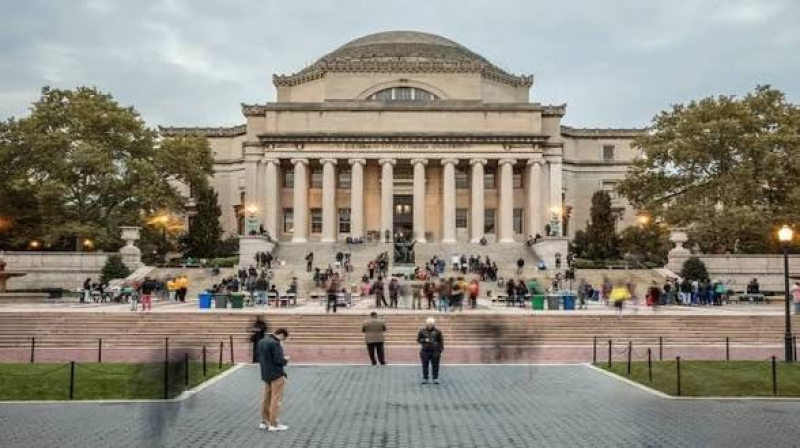
Students sit on the front steps of Low Memorial Library on the Columbia University campus in New York City.
International student enrollment at US universities has declined amid tighter immigration policies and changes to the higher education sector under the Trump administration, according to a report released on Monday.
Enrollment at US campuses fell by 9 percent this autumn compared with the same period last year, while the number of new international students entering the country dropped by 15 percent, according to a survey by the Institute of International Education (IIE).
“No one aspires to send their kids to get educated in the US,” said Veena Dubal, general counsel of the American Association of University Professors.
Her father travelled from India to study at Tuskegee University, then known as Tuskegee Institute, in the late 1960s on a student visa.
“It feels like an unsafe place. That's the message that the Trump administration has been sending to families all over the world and they're listening,” she added.
Last year, the decline in new international student enrollment was partly offset by graduates who remained in the US temporarily to work. However, the Department of Homeland Security (DHS) has proposed imposing a $70,000 fee on educational institutions for each student participating in the Optional Practical Training (OPT) programme.
Although the proposal has yet to be finalised, participation in OPT fell by 6 percent this autumn, the IIE survey found.
Immigration policies create uncertainty
The proposed fee, which is expected to face legal challenges, is part of broader DHS measures affecting international students. These include the termination of the legal status of thousands of students, as well as the detention and deportation of others.
The administration also finalised a rule this summer that would prevent international students from staying in the US for more than four years without federal government approval. However, a judge has temporarily blocked its implementation.
DHS Secretary Markwayne Mullin said the measures were intended to close loopholes that international students had been exploiting to extend their studies.
Although the US remains the world's leading destination for international students, the policy changes are already affecting its appeal, university leaders told the IIE.
Of more than 800 US colleges and universities surveyed this autumn, 88 percent identified the visa application process and 70 percent cited travel restrictions as factors contributing to the decline in enrollment.
The survey also found that 95 percent of institutions expected international students to consider other countries if access to OPT opportunities became more restricted. The findings offer an early indication of enrollment trends ahead of the release of comprehensive data next year.
Mirka Martel, the institute's head of research, evaluation and learning, said immigration policies were not the only factor influencing students' decisions. Growing international competition and the rising cost of studying in the US were also contributing to the decline.
Fanta Aw, executive director and CEO of NAFSA, an association representing international education, said concerns over research funding were another factor.
Last year, the Trump administration began dismantling the federal grant-awarding process and seeking greater political influence over decisions on which research projects receive funding.
“Too much uncertainty in the United States. It's too difficult, and, more importantly, we have many more choices today than we did 10 years ago. Why subject ourselves to this?” Aw said, describing the concerns of prospective students.
She noted that some students were increasingly considering alternative destinations, including China.
A study by NAFSA, conducted in partnership with international education technology company JB International, found that the decline in international student enrollment had reduced their contribution to the US economy by $2.4 billion this autumn.
Universities face financial pressure
US colleges and universities rely heavily on international students as an important source of tuition revenue, and declining enrollment has created financial challenges for some institutions.
At Cleveland State University, international student enrollment fell by 46 percent over two years, dropping from 1,542 in autumn 2025 to 828 this autumn.
Fewer than 50 new international students enrolled at the university this autumn, said Provost Nigamanth Sridhar, estimating the resulting financial impact at between $2 million and $4 million.
Sridhar, who is originally from India, came to the US decades ago on an F-1 student visa and participated in the OPT programme before eventually becoming a naturalised citizen.
“I am here in this position, in this job, because I had the opportunity to come to the United States as an international graduate student and then decided to stay here and build a career,” he said.
“So international education is personal to me,” he added.
The decline was particularly pronounced among graduate students. International graduate enrollment dropped by 15 percent this autumn, compared with a 3 percent decrease at the undergraduate level.
The report also recorded a decline in the number of students from India, the largest source country for international students in the US.
Midterm elections may influence future policies
Sarah Spreitzer, vice president of the American Council on Education, which represents college and university presidents, said major immigration legislation was unlikely while Trump remained in office.
However, she suggested that congressional oversight could help prevent further policies targeting international students.
“Those types of things could provide more certainty for our international students that there's not just going to be these sudden or unexplainable changes,” Spreitzer said.