

- PM Stresses Education, Health for Nation-Building |
- Australia hold off Bangladesh fightback to seal T20I series |
- Brahmaputra erosion leaves 30 families homeless in Kurigram char |
- Held 30 years after murder: Prime accused in Netrokona jail |
- Govt approves draft of Gambling Prevention Act, 2026 |
Nuclear Risks Test Global Pact at UN Talks Next Week
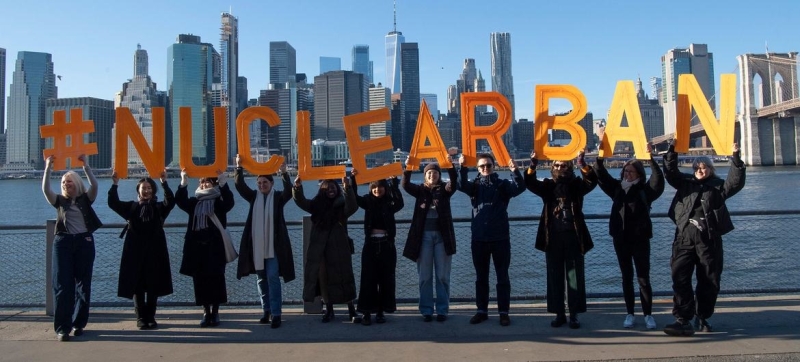
Campaigners in New York call for a ban on nuclear weapons (file)
At a time of rising nuclear risk and deepening global mistrust, governments from nearly every country will convene at the United Nations next week to confront a critical question: can the world’s main barrier against the spread of nuclear weapons still hold?
The Treaty on the Non-Proliferation of Nuclear Weapons (NPT) is widely regarded as one of the organisation’s most significant achievements. In force since 1970, it was designed to curb the spread of nuclear weapons, advance disarmament, and promote the peaceful use of nuclear energy.
The treaty has been ratified by 191 member states, making it one of the most widely adopted multilateral agreements and a cornerstone of global security. Over the past 54 years, nuclear weapons have not been used in conflict, with the 1945 bombings of Hiroshima and Nagasaki remaining the only instances of atomic weapons being deployed in war.
Entering uncharted territory
However, the global framework governing nuclear arms is now facing its most serious challenge in decades. Several Cold War-era agreements have either lapsed or been abandoned. The 2010 US-Russia New START treaty, which limited the deployment of strategic nuclear warheads, expired in February without a replacement.
At the time, UN Secretary-General António Guterres warned that the world was entering “uncharted territory,” with no legally binding limits remaining on the nuclear arsenals of the United States and Russia, which together possess most of the world’s nuclear weapons.
This growing mistrust has also been reflected in recent NPT review conferences. Meetings in 2015 and 2022 both ended without agreement on a final document, highlighting deep divisions among states over priorities and commitments.
This year’s review conference, scheduled from April 27 to May 22, will assess the treaty’s implementation and examine whether it can still deliver progress on disarmament and cooperation amid rising global tensions.
Speaking at a press briefing, UN High Representative for Disarmament Affairs Izumi Nakamitsu said the conference offers a chance for countries to find common ground despite an increasingly complex security environment.
“The threat of nuclear weapons use is becoming more frequent, and we do not want that to become normalised,” she said, warning that the risk of accidental use increases as more states acquire such weapons.
She added that the conference must go beyond a routine review, stressing that diplomats need to work toward a meaningful outcome as it will shape the future of the global nuclear order.