

- PM to visit India when atmosphere turns conducive: Humaiun Kobir |
- PM set to embark on maiden overseas tour with Malaysia visit Sunday |
- Food grain stocks in country exceed 20.6 lakh tons |
- Dhaka, Beijing Likely to Sign 15–17 Agreements |
- Govt Aims for Efficient Spending, More Revenue |
Experts Urge Skills-Based Education to Curb Child Labour
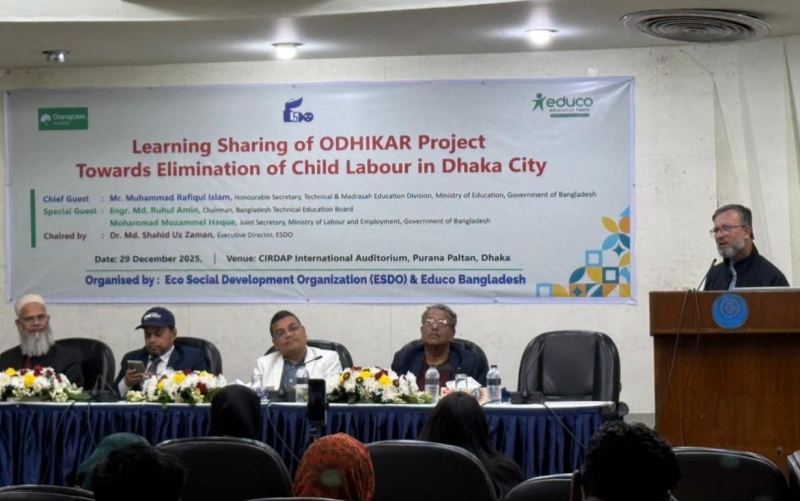
Representatives from government and non-government organisations have stressed the importance of job-oriented education as a key strategy to end child labour, calling for stronger community-based child protection systems and coordinated, multi-sectoral initiatives to tackle the problem sustainably, particularly in urban areas.
The observations were made at an experience-sharing programme held on Monday at the CIRDAP Auditorium in the capital. The event was organised by the Eco Social Development Organisation (ESDO) with support from Educo Bangladesh to present the implementation progress of the “Adhikar” project aimed at eliminating child labour.
The programme was chaired by ESDO Executive Director Dr Md Shahid-uz-Zaman and moderated by Educo Bangladesh Project Officer Md Mizanur Rahman. The function was addressed, among others, by Secretary of the Technical and Madrasa Education Division Muhammad Rafiqul Islam, Chairman of the Bangladesh Technical Education Board Engineer Md Ruhul Amin, Joint Secretary of the Ministry of Labour and Employment Mohammad Mozammel Haque, and Educo Bangladesh Director Abdur Rahim.
Speaking at the event, Secretary Muhammad Rafiqul Islam said child labour remains a major barrier to national development. He emphasised the need to ensure quality education and job-oriented employment opportunities for all children. “The government is working on these issues, but child labour cannot be eliminated by the government alone. It requires collective efforts involving government bodies, local government institutions, civil society, the private sector and communities,” he said.
Bangladesh Technical Education Board Chairman Engineer Md Ruhul Amin said child labour can be prevented by transforming policies into practical and effective strategies. He noted that efforts are underway to build a skilled workforce through technical education and that around 20 per cent of students are currently enrolled in technical streams. “This number must increase to achieve our desired goals,” he said, adding that the board is ready to provide all necessary support to private organisations working in this area.
Joint Secretary Mohammad Mozammel Haque said collective social initiatives can play an effective role in eliminating child labour. Identifying poverty as the root cause, he stressed the need for effective poverty alleviation measures and greater emphasis on technical education to bring about real change.
Dr Md Shahid-uz-Zaman said that although the government, NGOs and development organisations are playing important roles in preventing and rehabilitating child labour, there is a lack of sustainable action plans. He called for aligning child labour elimination initiatives with urban development planning and for integrated strategies covering housing, health and education to ensure lasting solutions.