

- Israeli Assault Has Plunged Gaza Into Worst Economic Collapse |
- Woman sent to jail on charges of killing 8 puppies in Pabna |
- UN Assembly Urges Decisive Action to Resolve Israel-Palestine Conflict |
- Sediment-borne fertility transforms northern Bangladesh |
- 3 Armed Forces Chiefs, Jamaat Ameer visit Khaleda Zia at Hospital |
Inclusion of Persons with Disabilities Benefits Everyone
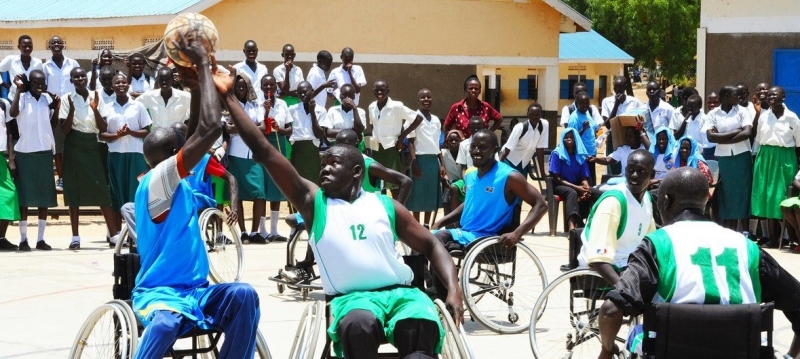
Athletes with disabilities play wheelchair basketball in South Sudan. (file 2012)
Discussions on promoting greater inclusion of people with disabilities topped the agenda at the United Nations on Wednesday.
“When inclusion is real, everyone benefits,” UN Secretary-General António Guterres said in his message to mark the International Day of Persons with Disabilities.
He stressed that people with disabilities drive progress that benefits all, highlighting how their leadership has improved disaster preparedness, expanded inclusive education and employment, and ensured that humanitarian responses reach those most at risk.
‘Structural failures’ persist
The head of the UN Department of Economic and Social Affairs (DESA), Li Jinhua, recalled that at the Second World Summit for Social Development held last month in Doha, the international community reaffirmed that real social progress is only achieved when everyone is included.
Yet persons with disabilities continue to face obstacles to integration, including higher multi-dimensional poverty. They are also twice as likely to be unemployed and often excluded from a world moving increasingly online.
“These are not just statistics. They are structural failures that undermine our collective potential,” he said in a recorded message at a virtual event to commemorate the Day.
Deaf youth lead at the UN
Participants included representatives from the Deaf Leaders of Tomorrow Foundation (DLTF), an international non-profit spearheading a youth-led pilot initiative on sign language rights at the UN.
It involves training at DLTF, Gallaudet University—the world’s first institution for deaf and hard-of-hearing students—and at UN Headquarters in New York, so deaf youth gain a foundation in human rights frameworks, disability rights principles, diplomacy, and global advocacy.
The initiative not only trains young leaders but also “strengthens global development, moving from the disability framework to the human rights framework,” DLTF’s Yana Hadjihristova said in sign language.
She urged Member States and UN agencies to integrate sign language rights into all youth frameworks, adopt a global sign language equity strategy, and ensure deaf youth play a bigger role in decision-making.
“The message we bring is simple and powerful,” she said. “Sign language creates leaders. Deaf leaders create inclusion. When the United Nations promotes sign language equity, the entire human rights system becomes stronger.”
From commitment to action
In Doha, countries adopted a declaration outlining “a clear blueprint” for full inclusion and participation of persons with disabilities, said Mr. Li.
Actions include social policies and programmes on integration, ensuring inclusive, accessible, and equitable health services, housing, education, universal social protection, and employment opportunities.
He said UNDESA is fully committed to supporting Member States in turning commitments into national policy.
“As we move forward, let us remember that societies that work for persons with disabilities are resilient, equitable, and prosperous for all, leaving no one behind.”
Advocacy over inspiration
In New York, the outgoing UN Global Advocate for Persons with Disabilities in Conflict and Peacebuilding Situations said he felt he had failed in the position, noting that conditions for this population have not changed.
Photojournalist Gilles Duley, who lost three limbs in Afghanistan, said his job is to share frontline stories rather than provide inspiration.
“I'm not here as an advocate to inspire people. My job is to share stories because the reality on the ground for people with disabilities has not changed,” he said.
Mr. Duley added that too often, persons with disabilities are presented as inspirational and resilient, which they are, “but this means the stories of those left behind who are truly vulnerable are often ignored or forgotten. We can't romanticize the idea of disability.”