

- A costly bridge in Manikganj remains idle sans approach roads |
- Dhaka’s air quality records ‘unhealthy’ amid fog Saturday morning |
- Record low ADP execution rate clouds performance in 2025 |
- Special prayers held nationwide for Khaleda after Jumma prayers |
- Vandalism at Chattogram Airport for food after flight cancellations |
Cervical Cancer Kills One Woman Every Two Minutes: UN
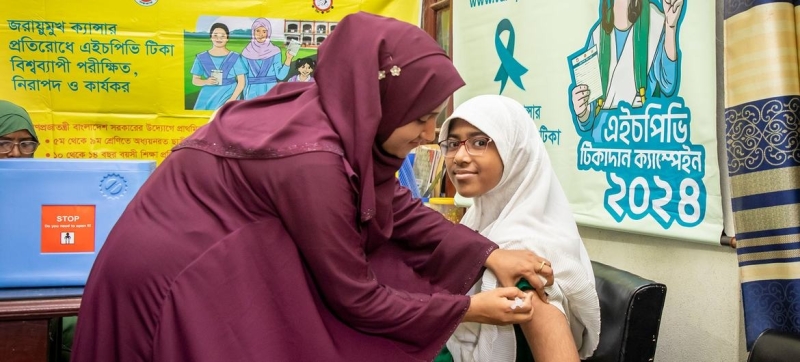
A girl in Mymensingh, Bangladesh, receives an HPV vaccine which can help to prevent cervical cancer.
A flood of questions overwhelmed Jeanette after she was diagnosed with cervical cancer. Would she be unable to conceive a child? Would she be forced into menopause at the early age of 31?
“I felt betrayed by my body,” she told the World Health Organization (WHO) as part of an initiative to eliminate the disease.
Cervical cancer, the fourth most common cancer among women, claimed Jeanette’s life just a year after her diagnosis. Each January, during Cervical Cancer Awareness Month, WHO highlights that the disease is both preventable and curable.
What is cervical cancer?
Cervical cancer is a reproductive cancer that develops in a woman’s cervix and can spread to other parts of the body if not detected or treated early.
In 2022, an estimated 660,000 women were diagnosed with cervical cancer worldwide, and about 350,000 died from the disease, according to WHO.
UNICEF, the UN children’s agency, warns that a woman dies from cervical cancer every two minutes.
Almost all cases are linked to infection with human papillomavirus (HPV) — an extremely common virus transmitted through sexual contact. Most sexually active people will contract HPV at some point in their lives. In most cases, the immune system clears the virus naturally. However, persistent infection with certain cancer-causing strains can lead to abnormal cell growth that may eventually develop into cancer.
Prevention and treatment
Cervical cancer is both preventable and curable with proper access to vaccination, screening and treatment.
WHO recommends HPV vaccination for all girls aged 9–14, before they become sexually active, and cervical screening from the age of 30 — or from 25 for women living with HIV.
When detected early and treated effectively, cervical cancer is one of the most successfully treatable forms of cancer.
However, unequal access to prevention and treatment remains a major challenge. This disparity leads to higher rates of illness and death in regions such as sub-Saharan Africa, Central America and Southeast Asia.
Global response
In 2020, 194 countries launched a global strategy to eliminate cervical cancer. The launch date, November 17, is now observed as World Cervical Cancer Elimination Day.
The strategy outlines three targets to be achieved by 2030:
90 percent of girls fully vaccinated against HPV by age 15
70 percent of women screened with a high-performance test by age 35 and again at 45
70 percent of women diagnosed receiving appropriate treatment
According to estimates, achieving these targets could prevent 74 million new cases and avert 62 million deaths by 2120.