

- Rosatom Launches Bangladesh's First Nuclear Power Plant |
- Govt Approves Bogura City Corporation, 5 Upazilas |
- Parliament’s Budget Session to Begin on June 7 |
- BSF drone in BGB custody after crashing inside BD territory |
WHO Says Cruise Ship Virus Not Another COVID
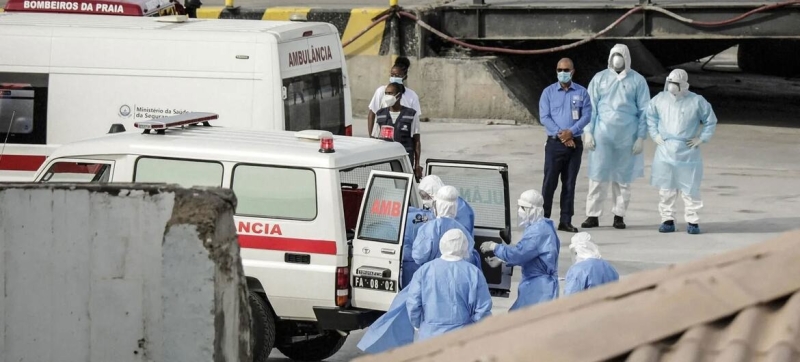
A person with a suspected case of hantavirus is moved to an ambulance in Cabo Verde.
A deadly hantavirus outbreak aboard a cruise ship in the Atlantic Ocean poses a low global public health risk and is “not the start of another COVID pandemic,” the World Health Organization (WHO) said on Thursday.
Three people have died and several others have fallen ill aboard the Dutch-flagged MV Hondius, prompting a major international public health response involving countries across Europe, Africa and Latin America.
The first alert came from the United Kingdom, which notified WHO under the International Health Regulations after passengers aboard the vessel developed severe respiratory illness during the trip from Argentina to Cabo Verde.
Briefing journalists in Geneva, WHO Director-General Tedros Adhanom Ghebreyesus said eight cases had been reported so far, including five laboratory-confirmed infections and three suspected cases linked to the rare Andes strain of hantavirus.
Low Risk to Humans
Hantaviruses are zoonotic viruses carried by rodents and are usually transmitted to humans through contact with infected animals or their urine, saliva or droppings.
The Andes strain, found in parts of Latin America, is the only known hantavirus capable of limited human-to-human transmission.
According to WHO, transmission generally requires close and prolonged contact, particularly among household members, intimate partners or healthcare workers.
“At this stage, the overall public health risk remains low,” Dr. Tedros said.
WHO officials stressed that the outbreak is very different from the 2020 coronavirus pandemic that killed millions worldwide.
“This is not SARS-CoV-2. This is not the start of a COVID pandemic,” said Maria Van Kerkhove, acting director for epidemic and pandemic management at WHO.
“Hantaviruses have been around for quite a while. We know this virus. It does not spread the same way that coronaviruses do,” she added.
Investigation Underway
The first known patient developed symptoms on April 6 and later died aboard the vessel. His wife also became ill and died after being evacuated to South Africa, where laboratory testing confirmed hantavirus infection.
Before boarding the ship, the couple had travelled through Argentina, Chile and Uruguay on a birdwatching trip, including visits to areas where rodents known to carry the virus are found.
Another passenger died on May 2, while one man remains in intensive care in South Africa. WHO said his condition is improving. Other patients have been transferred to hospitals in the Netherlands for treatment.
WHO said no passengers or crew members currently aboard the ship are showing symptoms.
International Response
The outbreak has triggered action under the International Health Regulations, the global framework designed to coordinate responses to cross-border health threats.
WHO said it is working closely with authorities in Cabo Verde, Spain, the Netherlands, South Africa, the United Kingdom and Argentina, alongside the European Centre for Disease Prevention and Control.
Spain agreed to allow the vessel to dock in the Canary Islands after Cabo Verde declined the request because of public health concerns.
Dr. Tedros thanked Spanish Prime Minister Pedro Sánchez for what he described as an act of “solidarity” and “moral duty.”
“The risk to the people of the Canary Islands is actually low,” he said.
WHO Mission in Cabo Verde
A WHO expert, Dutch doctors and a European disease specialist boarded the ship in Cabo Verde earlier this week and are overseeing medical assessments and infection prevention measures during the voyage to Tenerife.
Speaking to reporters, WHO Representative in Cabo Verde Ann Lindstrand said the agency had been supporting local authorities since the beginning of the outbreak response.
She said medical supplies had been delivered to the vessel to ensure doctors could care for anyone who becomes ill during the journey.
Health authorities are also contacting passengers who disembarked earlier and advising them to seek medical attention immediately if symptoms develop.
Passengers still aboard have been asked to remain in their cabins while disinfection procedures continue. Anyone developing symptoms will be isolated immediately.
Social Media Misinformation
Addressing misinformation circulating online, Abdirahman Mahamud said there is no indication the outbreak represents the early stages of a pandemic.
He noted that infections occurred in a confined setting involving prolonged close contact among passengers, similar to a limited Andes hantavirus outbreak recorded in Argentina between 2018 and 2019.
According to WHO, existing public health measures, including contact tracing, isolation and monitoring, are well understood and capable of preventing wider transmission.
WHO warned that additional cases may still emerge because the incubation period for Andes hantavirus can last up to six weeks.
“Viruses don’t care about politics, and they don’t care about borders,” Dr. Tedros said. “The best immunity we have is solidarity.”