

- Govt Proposes 17-Member Panel for Constitution Reform |
- Energy Security Lies in in Solar Power |
- Breaking The Iron Grips of Oligarchy in Bangladesh |
- PM Unveils 12-Point Plan for Clean, Green Dhaka |
- Fuel shortage, rains hit Boro harvest in Habiganj haors |
Learning to Live in Harmony With The Sundarbans
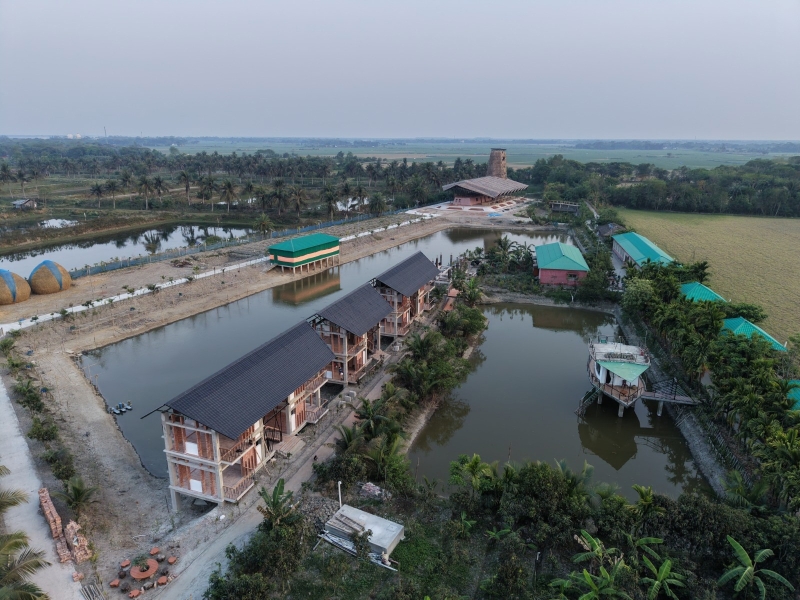
Overview of Sundarbans Eco-Village in Dacope, Khulna
In a quiet coastal area near the world’s largest mangrove forest, nature lovers have initiated an organised move to tune a village to the chores of the Sundarbans by piecing together the relationship between people and nature.
At North Banishanta under Dacope upazila of Khulna, the Sundarbans Ecovillage is emerging as a community-driven initiative that combines mangrove restoration, livelihood creation and environmental education within a single integrated system.
The project, led by Bangladesh Environment and Development Society (BEDS), is built on a simple but ambitious idea: conservation becomes more effective when it is directly linked to community survival.
Md Maksudur Rahman, Chief Executive of BEDS, said the objective is to allow people to experience the essence of the Sundarbans without entering its most sensitive core zones.
“We have already planted around 15 to 16 species of mangrove plants in the ecovillage and are working to create a Sundarbans-like environment here,” he said.
The concept emerged from a pressing concern. For years, floating mangrove seeds drifting through rivers and canals were collected and often used as fuel by local households. While this met immediate energy needs, it disrupted natural regeneration processes in the forest.
“We realised that this practice was unintentionally harming the future of the forest. So, we trained local communities to collect seeds and produce saplings instead. Now many nurseries have been established, and people are earning additional income while supporting restoration,” Rahman added.
This shift has gradually transformed local practices. Small nurseries have become part of household economies, turning previously unused natural material into a sustainable livelihood source.
The ecological impact is becoming visible along riverbanks. BEDS has planted around one million saplings across nearly 200 hectares of char land along the Pashur and Dhangmari rivers. These green belts are gradually strengthening natural protection against cyclones, tidal surges and erosion.
For residents like Sabuj Mondal, a battery-run auto-rickshaw driver from Kakrabunia, the changes are both practical and reassuring.
“As part of the afforestation work, BEDS planted a large number of saplings along the riverbanks. I believe these trees will help protect us from cyclones and tidal surges,” he said.
Beyond environmental protection, Sabuj pointed to another visible improvement in daily life.
“This initiative has created employment opportunities. It has also made safe drinking water available at a low cost, which is very important for us,” he said.
Access to safe drinking water has long been a critical challenge in the coastal belt, where salinity intrusion has contaminated many traditional sources. The ecovillage has introduced water systems that provide clean water at affordable rates, easing one of the most persistent burdens on local households.
The initiative is structured around three core pillars: green housing, green education and green business.
Green housing focuses on climate-resilient, eco-friendly construction suitable for coastal conditions. Green education promotes awareness, skill development and environmental learning. Green business ensures that conservation is linked with income generation, making the model economically sustainable for communities.
At the centre of the economic framework is the Sundarbans Resource Harvesters Cooperative Society, locally known as BANOJIBI. This cooperative brings together forest-dependent communities and supports them in developing and marketing mangrove-based products.
Around 265 members and their families are engaged in activities ranging from eco-tourism to production and branding of value-added goods. These include mangrove honey, tea, juice, pickles, molasses and handicrafts.
By shifting from raw resource extraction to value-added production, the cooperative is helping reduce pressure on forest resources while improving household incomes. For women in particular, the transformation has been significant.
Kalpana Biswas, a member of the cooperative society, said the initiative has created opportunities across five unions under Water Development Board Polder No-33 in Dacope upazila.
“We, the women in this area, had no source of income before. Now we can earn by collecting seeds, producing saplings and making mangrove-based products on a daily basis. We also receive a share of the annual profit from the organisation,” she said.
Kalpana’s story carries both resilience and hardship. A mother of two, she lost her husband in November last year and is currently battling cancer. Despite these personal challenges, she continues to work through the cooperative system.
She also recalled one of the earliest interventions of the project, which addressed the drinking water crisis in the region.
Her experience reflects a broader shift in the region, where environmental interventions are increasingly linked with basic service delivery and livelihood support.
The ecovillage model has expanded beyond North Banishanta. BEDS has extended similar activities to Burigoalini in Shyamnagar, Smoronkhola, Nalian and Chadpai, focusing on mangrove restoration, eco-tourism and alternative income generation.
M Zakir Hossain Khan, Chief Executive Officer of Change Initiative, said the mangrove centre being developed by BEDS presents a timely opportunity.
“The mangrove centre by BEDS will offer an opportunity to institutionalise evidence-based interventions in mangrove protection by applying natural rights-led governance,” he said.
He said the model extends beyond conservation alone.
“It can advance nature justice by ensuring that policies reflect ecological realities as well as the rights of communities, while strengthening ecosystem protection through community stewardship,” he said.
The ecovillage is also developing into a centre for training and research. Md Shafiqul Islam, Programme Director of BEDS, said it will take around two more years after construction to complete the museum’s research and exhibition components.
He noted that eco-cottages have already been built, allowing accommodation for 40 to 50 visitors, including students and researchers. These facilities are intended to support training programmes, field studies and knowledge exchange.
At the centre of the ecovillage stands a mangrove museum, now nearing completion. Once fully operational, it will serve as a learning and interpretation space, showcasing the biodiversity, ecological importance and cultural heritage of the Sundarbans. Surrounding it, an arboretum is being developed with multiple mangrove species to recreate a miniature version of the forest ecosystem.
The infrastructure of the ecovillage includes solar energy systems, safe drinking water facilities, integrated waste management and mixed livelihood systems that combine agriculture, fisheries and forestry.
Visitors are able to observe a functioning model of sustainable coastal living, where resource use and conservation are closely linked.
The project began in 2015 with support from international partners and has since expanded through collaborations with organisations including the Korean Green Foundation, Japan Environmental Education Forum, Global Nature Fund, Give2Asia, One Tree Planted, Earthday.org and Milkywire Foundation. More recently, the UNDP-GEF Small Grants Programme has supported women-led livelihood initiatives and ecosystem restoration efforts.
These partnerships have helped scale the initiative while maintaining its community-driven foundation.
At its core, the Sundarbans Ecovillage represents a shift in approach. Instead of treating conservation and livelihoods as separate priorities, it integrates them into a single framework.
The Sundarbans itself remains both a lifeline and a vulnerable ecosystem. It protects millions of people from cyclones and tidal surges while supporting fisheries, honey collection and agriculture. Yet climate change, rising salinity and overdependence on forest resources continue to place it under pressure.
Around 3.5 million people depend directly or indirectly on this forest system.
For many of them, survival has long meant managing uncertainty.
The ecovillage offers an alternative path where communities are not positioned as users of the forest alone, but as active participants in its regeneration.
BEDS leaders describe it as a shift from extraction to regeneration, grounded in local knowledge, shared responsibility and long-term resilience.
In North Banishanta, that idea is slowly becoming visible. Young mangrove plantations now line riverbanks that were once exposed and vulnerable. Around them, livelihoods are beginning to change, shaped by a closer and more balanced relationship between people and the ecosystem that sustains them.
If expanded further, the model could offer a scalable approach for other climate-affected coastal regions, showing how environmental protection and community wellbeing can evolve together rather than compete. (This story has been published in the April print edition of the GreenWatch)