

- Academics Allegedly Targeted for Supporting Hasina: HRW |
- Dhaka Ranks 7th Among World’s Most Polluted Cities on Wednesday |
- 4 killed in bus- auto-rickshaw collision at Mirpur |
- PM Pushes Plans for Second Padma, Jamuna Bridges, Barrage |
- Tap grants, local finance; shun loans for energy sovereignty |
Breaking the SAFF jinx, is Bangladesh prepared for glory?
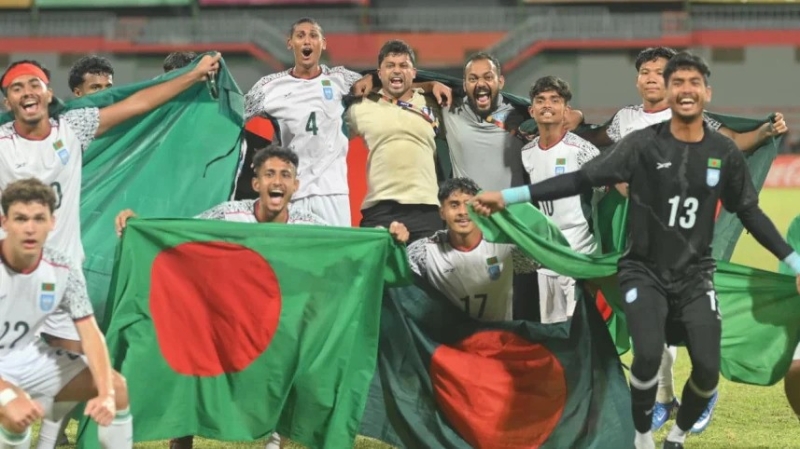
Dhaka, 4 Nov- Bangladesh are hoping to end their two-decade wait for the SAFF Championship title when they host the region's premier football tournament, but home advantage alone may not be enough to turn their ambition into reality.
Bangladesh will host the prestigious SAFF Championship scheduled to be held from November 5-17 at National Stadium in Dhaka.
Bangladesh won their maiden and only SAFF Championship title backed in 2003 on home soil. They reached the final again in 2005 but have since struggled to maintain consistency, failing to progress beyond the group stage in several subsequent editions.
With the championship returning to Bangladesh, expectations among football fans are running high. However, playing at home brings both the advantage of familiar conditions and passionate support and the pressure of performing in front of an expectant crowd.
Former national footballer and celebrated striker Zahid Hasan Ameli, who featured in five SAFF Championship editions, talking to BSS firmly expressed his optimism that Bangladesh have a genuine opportunity to reclaim the regional crown.
"Bangladesh has a good chance this time, a very good chance. Since we are the host country and have a solid team with quality players, everything aligns to give Bangladesh a strong shot at winning the SAFF title," he said.
The inclusion of expatriate players with international experience, including Hamza Choudhury and Shamit Shome, has added depth and quality to the national squad.
However, Ameli cautioned that having a strong squad on paper would count for little unless the players delivered on the field.
"The condition is that players must perform. Given the recent performances in Indonesia and other matches, questions naturally arise about whether Bangladesh can deliver. SAFF is a different kind of tournament. To become champions here, you have to play your absolute best football," he said.
Ameli also highlighted the psychological pressure of playing a major tournament at home, saying the expectations of millions of supporters could become a challenge for the players.
Drawing on his experience in five SAFF tournaments, he said having a good squad and home advantage did not automatically guarantee success.
"In SAFF, it often feels like you are destined to win-you have a good squad, home advantage, and everything in your favour. But once the tournament begins, the reality changes drastically. The pressure builds up because the entire country focuses on SAFF. How many players in the squad can handle this pressure and perform? Aside from a few, delivering your best performance under such pressure is extremely tough," he observed.
The former striker also questioned whether frequent coaching changes were responsible for Bangladesh's prolonged struggle for success.
According to Ameli, retaining a coach for a long period does not necessarily guarantee results, as national team football demands immediate performances.
"Retaining a coach long-term doesn't guarantee success either. That is the nature of national team football-you rarely get much time. The national team is about immediate results; it's senior-level football. There isn't much time to gradually rebuild or progress. This is the global reality of football. Changing coaches eventually becomes a necessity-if a coach cannot deliver success, changes will happen," he said.
Ameli identified the poor standard of domestic football as another major reason behind Bangladesh's failure to achieve sustained international success.
Comparing the present situation with the period when Bangladesh won the SAFF title in 2003 and finished runners-up in 2005, he said the domestic league had lost much of its competitiveness and public appeal.
"The quality of our domestic league is very poor, which is why the national team repeatedly fails. When we won SAFF in 2003 or reached the final in 2005, the domestic league was competitive and had the public's focus. Today, the league lacks standards, pitch conditions are poor, and players lack the motivation to perform," he said.
He also expressed frustration over the lack of progress in youth and grassroots football development despite repeated discussions over the past two decades.
"We've been talking about youth setups, grassroots, and club youth systems for the past twenty years, but ultimately no real change has occurred. Without these foundations, new talent won't be produced," he added.
The shortage of quality local goal scorers has also emerged as a concern, with the national team increasingly relying on expatriate players to strengthen its attack.
Ameli stressed that recruiting individual players alone would not solve the problem, as long-term improvement requires quality footballers and a united team effort.
As Bangladesh prepare for the home championship, team unity, composure under pressure and clinical finishing could prove decisive in their quest for the title.
For millions of football fans, the hope is to see the Red and Greens repeat their 2003 achievement and bring the SAFF trophy home once again.BSS