

- With Canal Digging Tarique Revives Zia's Legacy |
- Trans Fat From Edible Oil Reuse Causing Health Risk for Millions |
- Medicinal Plant Farming Turns Lucrative as Demand Soars |
- Trump reviews peace plan; UN calls for Hormuz to reopen |
- SC upholds Ex-Chief Justice Khairul Haque’s bail in 5 cases |
UN Pushes Trade Policy to Tackle Global Plastic Pollution
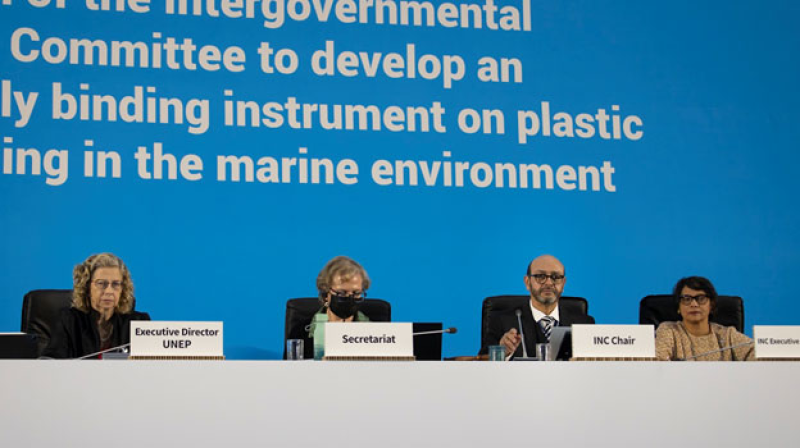
The closing plenary of INC-5.1 in Busan, Republic of Korea.
They are lightweight, cheap, and used in every sector of every supply chain. Few materials have revolutionised manufacturing and the global economy as much as plastics. They are essential in almost everything; however, this comes at a cost — an estimated USD 1.5 trillion annually in environmental damage and a 75 per cent waste ratio of all plastic ever produced.
Although there have been biodiversity protection agreements through the Paris Agreement and the Convention on Biological Diversity (CBD), no comprehensive global agreement has addressed the challenges that plastic pollution presents. To bridge this gap, the International Negotiating Committee (INC-5.2), mandated by the United Nations Environment Assembly resolution 5/14 in 2022, has been tasked with developing a legally binding instrument (ILBI) on plastic pollution. The latest round of negotiations is scheduled to take place in Geneva from 5 to 14 August this year.
During last year’s sessions in Busan, Republic of Korea, INC Chair Luis Vayas Valdivieso, the Ecuadorian ambassador to the United Kingdom, remarked: “Our mandate has always been ambitious. But ambition takes time to land.” He added: “I call on all delegations to continue making paths, building bridges, and engaging in dialogue. Let us always remember that our purpose is noble and urgent: to reverse and remedy the severe effects of plastic pollution on ecosystems and human health.”
This kind of damage affects at least 1,400 wildlife species annually. Plastics leak into marine ecosystems, and many developing countries — which are not the primary producers of this waste — lack sufficient capacity to collect, reuse, and recycle plastics. The reliance on fossil fuels to create plastics generates 1.96 gigatonnes (Gt) of CO₂ equivalent emissions. Plastics contribute to the triple planetary crisis of pollution, biodiversity loss, and climate change.
“We are choking on plastic,” said UN Secretary-General António Guterres. “Plastic pollution is all around us and even inside us — from our seas to our blood, to our brains… Every year, people may ingest the equivalent of up to fifty plastic bags due to microplastics in food.”
Global demand for plastic products is fulfilled through trade, making trade a major driver of plastic pollution. Much of global plastic production is designed for single use, which has grown from two million metric tonnes (MMT) in 1950 to 436 MMT in 2022 — a 217-fold increase. If current trade practices continue, annual production is expected to reach 884 MMT by 2050, growing at 2.65 times the historical rate.
In 2022, over 78 per cent — 323 MMT — of plastic produced was traded internationally in primary, intermediate, and embedded forms. The value of plastics trade has more than doubled since 2005, reaching USD 1.13 trillion, which accounted for 5 per cent of global merchandise trade that year.
Since trade drives plastic production, integrated environmental trade policy is essential to halt further environmental damage and control plastic flows. Such policies can incentivise investment in safer alternatives and promote effective waste management.
Tariff measures have proven effective in reducing plastic use by decreasing the market competitiveness of plastic products. A comprehensive value chain approach — analysing production, movement, and disposal — is needed. The removal of tariffs has driven plastic production growth; over the past 30 years, tariffs on plastics and rubber have fallen from 34 per cent to 7.2 per cent, largely due to the Uruguay Round Agreements under the World Trade Organization (WTO) and various free trade agreements.
By contrast, plant-based plastic alternatives have not benefited from such agreements, averaging 14.4 per cent in tariffs, limiting their competitiveness. Non-tariff measures (NTMs), such as technical regulations on product specifications, production methods, and packaging requirements, have been implemented to some extent — 195 of the 299 notified measures to the WTO fall into this category.
To further combat plastic pollution, UN Trade and Development (UNCTAD) has identified promising measures to replace plastics with sustainable alternatives in packaging, agriculture, and fisheries. UNCTAD’s database lists 274 traded products of plant, mineral, or animal origin — including glass, aluminium, paper, bamboo, seaweed, and natural fibres — that could replace plastics thanks to their biodegradable, compostable, and recyclable nature.
Currently, compostable and bio-based plastics are available in many markets, but they represent only 1.5 per cent of global plastic production. In 2023, global exports of non-plastic substitutes reached USD 485 billion, down from USD 561 billion in 2022, reflecting a small drop in plastic trade. Developed countries accounted for 58 per cent of these exports, while developing countries accounted for 42 per cent, showing a 5.6 per cent growth rate.