

- UK All-Party Parliamentary Group on BD Meets Humaiun Kobir |
- World Bank Keeps Bangladesh FY27 Growth Forecast at 3.4% |
- PM Joins Children’s Rights Day, Shishu Academy Anniversary |
- BATEXPO 2026 to showcase Bangladesh’s transformed RMG sector |
- Saudi Remittance Rises 38% as UAE, Malaysia Inflows Fall |
Food Waste Emits Five Times More Greenhouse Gases Than Planes
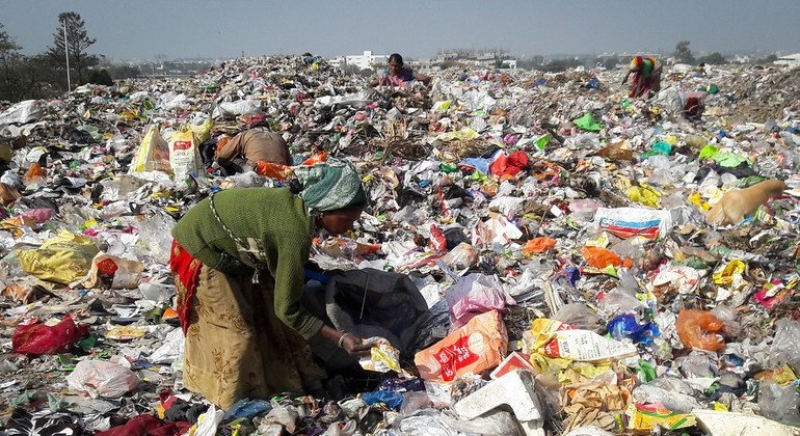
Waste pickers sort through a garbage dump in India.
Rotting food waste is responsible for up to 10 per cent of global greenhouse gas emissions — about five times more than the entire aviation sector, according to the UN Environment Programme (UNEP).
Food waste has become a major driver of the climate crisis, but solutions are already being deployed, ranging from community composting and formal waste-management systems to the use of black soldier flies to recycle organic waste.
### From kitchens to landfills
Food waste includes everything from unfinished meals to crops lost after harvest and before reaching markets.
However, food that ends up rotting in landfills is particularly harmful to the climate. When organic material such as uneaten food is buried and deprived of oxygen, microorganisms break it down and produce methane.
Methane is a powerful greenhouse gas responsible for nearly one-third of global warming. It traps significantly more heat than carbon dioxide over a 20-year period, making reductions in methane emissions particularly important for slowing warming in the near term.
Decomposing food waste is also a major source of methane emissions worldwide. In the United States, municipal solid-waste landfills are the third-largest source of human-related methane emissions.
### A mountain of wasted food
The scale of food waste is enormous. More than one billion meals are left uneaten every day, with households accounting for around 60 per cent of the waste.
Wasting food also means wasting the land, water and other resources used to produce it.
The Food and Agriculture Organization estimates that around 1.4 billion hectares of land — roughly 28 per cent of the world's agricultural land — are used to produce food that is never eaten. The water used to grow and prepare that food is also wasted.
Food waste can also contribute indirectly to deforestation because agricultural expansion remains a major driver of forest loss. Destroying forests reduces the amount of carbon dioxide that ecosystems can remove from the atmosphere.
### Calls for faster action
Methane remains in the atmosphere for a much shorter period than carbon dioxide, meaning that cutting methane emissions can deliver climate benefits within decades.
“At a time when the world is searching for practical ways to slow warming quickly, tackling food waste may be one of the most immediate and cost-effective climate solutions available,” said UNEP official Martin Krause.
Despite international commitments, however, the world has made little tangible progress in reducing food losses since 2015 and remains far from achieving the Sustainable Development Goal target of halving per-capita global food waste by 2030.
“We have to move faster,” Krause said.
### Waste pickers and black soldier flies
Countries are also testing practical ways to reduce methane from food and organic waste.
Eleven African governments have committed to reducing methane emissions by integrating waste pickers into formal waste-management systems and training them to sort and compost organic material.
With support from the Climate and Clean Air Coalition, these programmes have helped improve waste pickers' livelihoods, raise awareness of waste separation and establish community composting sites.
Another approach involves black soldier flies, which are being bred at specialised facilities and used to recycle organic material. From Malawi to Uganda, the insects are already being incorporated into waste-management systems in a growing number of villages and cities.
Reducing food waste can therefore cut methane emissions while conserving land and water, improving waste management and helping countries make faster progress towards their climate goals.