

- ‘May no other parent lose a child this way’, says Ramisa’s father |
- 5 killed as car crashes into truck on Faridpur expressway |
- Rawhide traders count losses as tanneries duck blame |
- Iran warns of suspending US talks if Israeli attacks on Lebanon continue |
- Girl missing after crocodile drags her into Bagerhat shrine pond |
Water Use Outweighs Sponge Microplastic Risk: Study
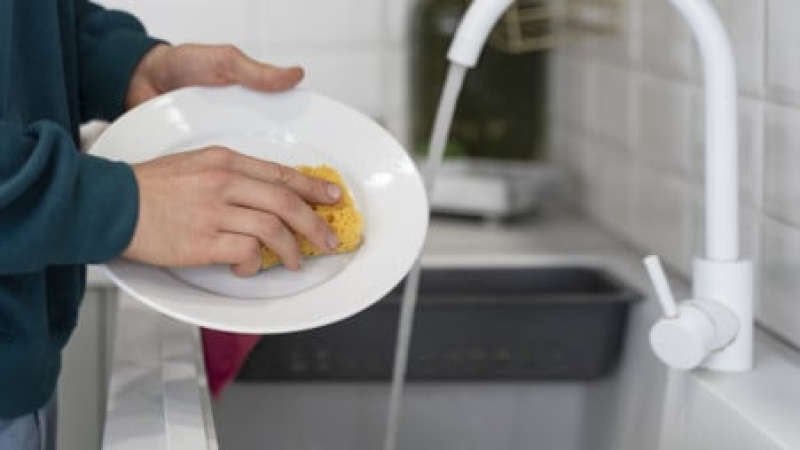
Representational image.
A new study has found that commonly used kitchen sponges release tiny plastic particles every time they are used for washing dishes, adding to growing concerns about microplastic pollution.
Researchers from the University of Bonn examined how much plastic is shed from sponges during normal household use and assessed their overall environmental impact.
The study shows that kitchen sponges do release measurable amounts of microplastics as they wear down over time. However, scientists found that the biggest environmental burden from handwashing dishes is not plastic pollution, but water consumption.
Microplastics released during everyday use
The research team studied how much material is lost from sponges during regular dishwashing. They combined laboratory experiments with real-life testing involving households in Germany and North America, where volunteers used different types of sponges in their daily routines.
Each sponge was weighed before and after use to measure material loss. Researchers also used a laboratory device called “SpongeBot” to simulate the pressure and friction sponges face during washing.
The study found that all tested sponges released microplastics, with annual emissions estimated between 0.68 grams and 4.21 grams per person, depending on the type of sponge used. Sponges with higher plastic content released more particles, while those with lower plastic content shed less.
Real-life usage improves accuracy
The inclusion of household participants helped researchers better understand real washing habits, making the results more reliable than lab tests alone.
Water use is the bigger environmental concern
Although the amount of plastic released by a single sponge is small, the study warns that the impact grows when scaled up. In Germany alone, widespread use of certain sponge types could lead to up to 355 tonnes of microplastics released annually.
Wastewater treatment plants can capture much of this waste, but some particles may still reach rivers, lakes, oceans and soil.
However, the study found that microplastics are not the main environmental concern. Around 85 to 97 percent of the environmental impact from manual dishwashing comes from water use, making it the dominant factor in overall damage.
How to reduce environmental impact
Researchers suggested a few simple steps to reduce the footprint of dishwashing:
Use less water while washing dishes
Choose sponges with lower plastic content
Use sponges for longer periods before replacing them
The research was conducted by scientists from the Fraunhofer Institute for Environmental, Safety and Energy Technology UMSICHT and Leiden University, along with the University of Bonn team, reports UNB.