

- First cruise ship crosses Strait of Hormuz since war began |
- MDBs stress co-op support global stability amid uncertainty |
- PM opens first Hajj flight, visits Ashkona camp |
- River ports asked to hoist cautionary signal No 1 |
- Oil prices drop 9% & Wall Street rallies to a record after Iran reopens Hormuz |
Explainer: How GEF Funds Global Environment Efforts
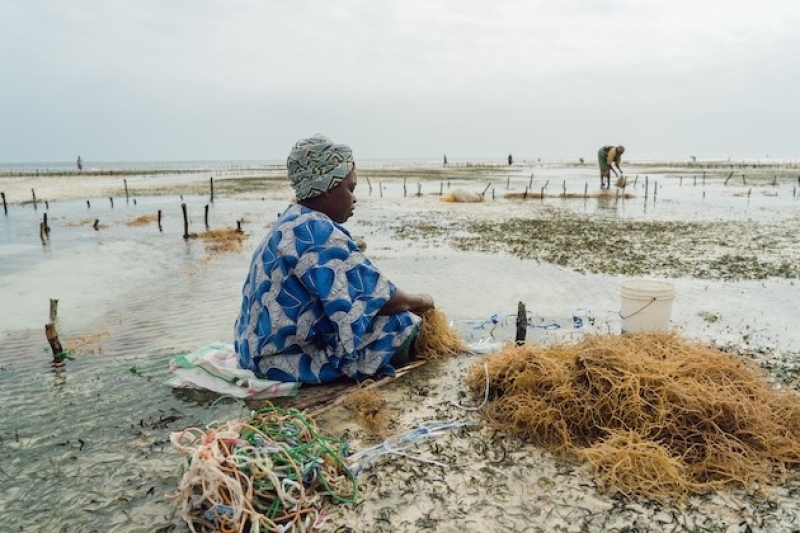
The GEF actively supports climate resilience and sustainable livelihoods in Zanzibar, with a specific focus on the seaweed farming sector, which is crucial for over 20,000 farmers—mostly women—in the region. Here a woman identified as Jazaa is pictured working as a seaweed farmer. She carefully attaches little seaweed seedlings to the rope that she will harvest after two months.
The Global Environment Facility (GEF) plays a central role in financing environmental protection worldwide. It supports developing countries in tackling climate change, biodiversity loss, land degradation, pollution and threats to ecosystems.
Since its establishment in the early 1990s, the GEF has grown into a major multilateral environmental fund, supporting projects in more than 170 countries.
Over time, it has evolved into what it calls a “family of funds”, with each fund targeting a specific global environmental challenge while operating under a shared strategic framework.
This explainer examines how GEF funding works, the origins of its financing model, and the role of six major funds that channel resources towards global environmental goals.
Origins of the GEF funding model
The GEF was created in 1991, ahead of the Rio ‘Earth’ Summit in 1992, which aimed to develop a global blueprint for balancing economic development with environmental protection. Its importance, however, grew significantly after the summit.
The Rio Summit produced three major environmental conventions: the United Nations Framework Convention on Climate Change (UNFCCC), the Convention on Biological Diversity, and, later in 1994, the Convention to Combat Desertification. The GEF became the financial mechanism for these agreements, mobilising and distributing funds to help countries implement them.
Over the past three decades, the GEF has expanded its mandate. Today, it supports multiple conventions and environmental initiatives through a structured set of trust funds. This architecture allows it to coordinate funding across different priorities while maintaining specialised programmes for each commitment.
The GEF now focuses on addressing environmental challenges in an integrated way, recognising that climate change, biodiversity loss and pollution are interconnected. It works with governments, international organisations, civil society and businesses to tackle these issues collectively.
Initially, the GEF Trust Fund supported multiple environmental agreements simultaneously. Over time, however, countries sought more targeted funding aligned with their specific needs. As a result, the GEF developed separate funds with distinct purposes and funding mechanisms.
Some funds, such as the Trust Fund, the Least Developed Countries Fund (LDCF) and parts of the Special Climate Change Fund (SCCF), use systems that allow countries to know in advance how much funding they can expect.
The GEF Trust Fund
The GEF Trust Fund remains the primary source of financing. It provides grants for environmental projects in developing countries across areas including biodiversity conservation, climate change mitigation, land degradation, international waters and chemicals and waste management.
Countries receive funding through the System for Transparent Allocation of Resources (STAR), which distributes funds based on environmental needs and eligibility.
Projects often focus on generating global environmental benefits, such as protecting endangered species, restoring ecosystems, reducing greenhouse gas emissions and improving pollution management.
The Trust Fund operates through replenishment cycles, with donor countries pledging contributions every four years. The upcoming GEF-9 cycle will run from July 2026 to June 2030, focusing on scaling up investment, mobilising private capital and strengthening national ownership.
The GEF has also introduced Integrated Programmes to address multiple environmental goals simultaneously. For example, the Food Systems Integrated Programme combines climate, biodiversity and land-use objectives into unified projects to improve efficiency and long-term impact.
Global Biodiversity Framework Fund
This relatively new fund supports implementation of the Kunming-Montreal Global Biodiversity Framework adopted in 2022. It aims to help countries meet ambitious targets, including protecting 30 percent of land and oceans by 2030.
It finances activities such as expanding protected areas, restoring ecosystems, protecting endangered species and strengthening biodiversity monitoring. It also promotes integrating biodiversity into economic planning by encouraging sustainable practices in sectors like agriculture and forestry.
At least 20 percent of its resources are directed towards Indigenous Peoples and local communities, a target that has already been exceeded.
Nagoya Protocol Implementation Fund
This fund supports implementation of the Nagoya Protocol on Access and Benefit Sharing, ensuring that genetic resources are used fairly and benefits are shared equitably.
It helps countries develop legal frameworks, strengthen monitoring systems and build capacity among researchers and policymakers. It also protects traditional knowledge held by Indigenous communities.
Least Developed Countries Fund
The LDCF focuses on climate adaptation in the world’s most vulnerable countries. It supports national adaptation strategies and projects such as climate-resilient agriculture, water management, coastal protection and early warning systems.
Special Climate Change Fund
The SCCF supports broader climate action in developing countries, including adaptation, infrastructure planning, disaster risk reduction and environmentally friendly technologies. It also supports some mitigation initiatives involving innovative solutions.
Capacity Building Initiative for Transparency Trust Fund
This fund helps countries meet transparency requirements under the Paris Agreement by strengthening emissions reporting systems, training officials and improving monitoring methods.
How the ‘family of funds’ works
A key feature of the GEF model is coordination among its funds. Rather than operating in isolation, they support projects from multiple angles, avoid duplication and align with global agreements.
This approach improves efficiency, flexibility and overall impact, allowing projects to address interconnected challenges such as climate change, biodiversity and land degradation simultaneously.
The future of GEF financing
As environmental challenges intensify, the need for funding continues to grow. The GEF aims to play a catalytic role by using limited public funds to mobilise larger investments from governments, development banks and the private sector.
Innovative mechanisms such as green bonds, debt-for-nature swaps and blended finance are expected to expand its impact, helping to bridge the global environmental financing gap.