

- Energy Security Lies in in Solar Power |
- Breaking The Iron Grips of Oligarchy in Bangladesh |
- PM Unveils 12-Point Plan for Clean, Green Dhaka |
- Fuel shortage, rains hit Boro harvest in Habiganj haors |
- 3 killed in truck-microbus collision in Kurigram |
Rooppur Nuclear Plant Cost Doubles India’s Benchmark
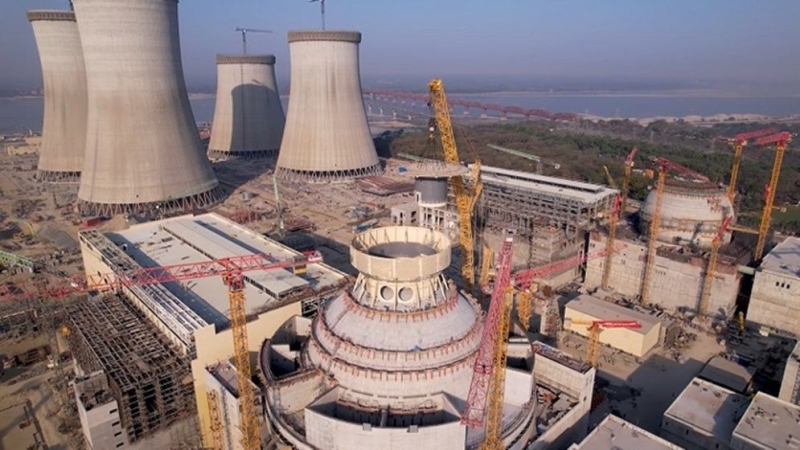
After a long wait, fuel loading has officially begun at Bangladesh’s Rooppur Nuclear Power Plant, the country’s largest infrastructure project. While the milestone marks progress, concerns are growing over its unusually high construction cost, which is reportedly double that of similar projects in neighbouring India and significantly higher than many European benchmarks.
Experts and officials say the cost gap has raised serious questions about project efficiency and oversight. According to multiple assessments and published studies, Bangladesh’s first nuclear power plant is far more expensive per unit of capacity compared to India’s Kudankulam Nuclear Power Plant, despite both being built with similar Russian technology.
A comparative study involving researchers from North South University and Bournemouth University found that the estimated electricity generation cost at Rooppur is about 9.36 cents per kilowatt-hour, while Kudankulam’s is around 5.36 cents. This suggests that electricity generation at Rooppur may cost nearly 75 percent more.
The capital cost difference is also significant. International estimates place Rooppur’s construction cost at around $12.65 billion, while comparable units at Kudankulam cost roughly $6.25 billion. This puts Rooppur’s per-kilowatt construction cost substantially higher than its regional counterpart.
Critics argue that repeated allegations of irregularities, procurement concerns, and lack of transparency have contributed to the rising costs. Some reports and investigations have previously linked the project to corruption allegations, though these remain under inquiry by relevant authorities.
Officials from the power sector, speaking anonymously, acknowledged that documentation related to cost breakdowns has not been fully transparent from the contractor side, raising further questions.
The Power Development Board (PDB), which will eventually purchase electricity from the plant, says pricing and final tariff structures are still under review.
A senior PDB official confirmed that negotiations on electricity purchase rates are ongoing and no final decision has been made yet.
Transparency International Bangladesh and energy experts have urged deeper scrutiny of the project’s financial structure, stressing that cost escalation in mega infrastructure projects often signals governance weaknesses.
Meanwhile, the fuel loading process for Unit-1 began on Tuesday, marking the final stage before trial electricity generation. Initial output of around 300 megawatts is expected by August, with full capacity to follow after testing and commissioning phases.
Each reactor unit has a capacity of 1,200 megawatts, making Rooppur a key addition to Bangladesh’s long-term energy mix.
Despite progress, the project continues to draw attention for its high cost, financing structure, and long-term economic burden on the national power sector.