

- Govt to cut savings certificate profit rates from January |
- Gold prices hit fresh record in Bangladesh within 24 hours |
- Election to be held on time, Prof Yunus tells US Special Envoy |
- Moscow wants Dhaka to reduce tensions domestically, also with Delhi |
- Saarc experts meet to reduce livestock-origin greenhouse gases |
Inflation Likely to Fall Below Seven Percent by June
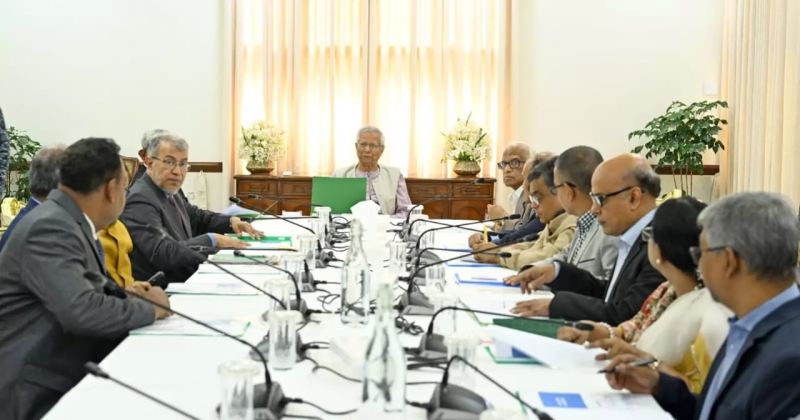
The government expects inflation to drop below seven percent by June 2026, driven by a contractionary monetary policy and continued austerity measures.
The outlook was shared at a high-level meeting held on Monday at the state guest house Jamuna, chaired by Chief Adviser Professor Muhammad Yunus. The meeting reviewed the country’s overall economic performance and budget implementation, according to an official statement.
Finance Adviser Salehuddin Ahmed, Planning Adviser Wahiduddin Mahmud and Bangladesh Bank Governor Ahsan H Mansur were among those present.
Key macroeconomic indicators—including inflation, wage growth, agricultural output, financial and external sector performance, remittance inflows, imports and the opening of letters of credit—were discussed at the meeting.
The 12-month average general inflation rate fell below nine percent in November 2025 for the first time since June 2023. Point-to-point inflation, which peaked at 9.33 percent in March 2023, dropped below nine percent in June 2025 and further declined to 8.29 percent in November.
The meeting also noted progress in narrowing the gap between inflation and wage growth, which had previously eroded real incomes. In November 2025, point-to-point inflation stood at 8.29 percent, while wage growth reached 8.04 percent, compared with average rates of 9.02 percent and 7.04 percent respectively in fiscal year 2022–23.
In the agriculture sector, officials said timely incentives and effective management resulted in a strong Boro harvest last fiscal year, while favourable conditions point to a good Aman harvest this season. As of December 15, Aman rice production stood at 16.095 million tonnes, with final output expected to exceed targets once harvesting concludes. Despite Aus rice production falling slightly short, total food grain output rose by 7.20 percent year on year.
The meeting observed that imbalances across several economic indicators are gradually moving toward stability.
On the external front, gross foreign exchange reserves reached $32.57 billion as of December 18, 2025, up from about $25 billion in August 2024. Officials expect reserves to increase further amid a stabilising exchange rate, higher remittance inflows and rising interest rates.
The current account deficit, which persisted from fiscal year 2016–17 through 2023–24, narrowed sharply to $139 million by the end of fiscal year 2024–25, following improved financial management and anti–money laundering measures. During July–October of the current fiscal year, the deficit stood at $749 million.
Overseas employment also showed gains, with jobs secured for 500,000 workers between July and November, up from 397,000 in the same period last year. Remittance inflows during this period rose 17.14 percent year on year to $13.04 billion.
Import growth, which was negative 1.2 percent during July–November of fiscal year 2024–25, rebounded to 6.1 percent in the same period of the current fiscal year. The opening of letters of credit for capital machinery rose from a negative 32.8 percent to 27.7 percent, while growth in LCs for industrial raw materials increased from 10.1 percent to 40.98 percent.
Overall, the meeting concluded that recent policy measures are helping steer the economy toward greater stability and recovery.