

- Bangladesh-Denmark May form Trade and Investment Committee |
- Bangladesh—Pakistan trade crosses $1 b |
- Dhaka Ranks 5th Among World's Most Polluted Cities on Friday |
- PM seeks to make Bangladesh a reliable brand in global livestock market |
- Türk warns of increased risk of atrocity crimes on Palestinians |
US Storms Disrupt Thanksgiving, Leave 1 Million Without Power
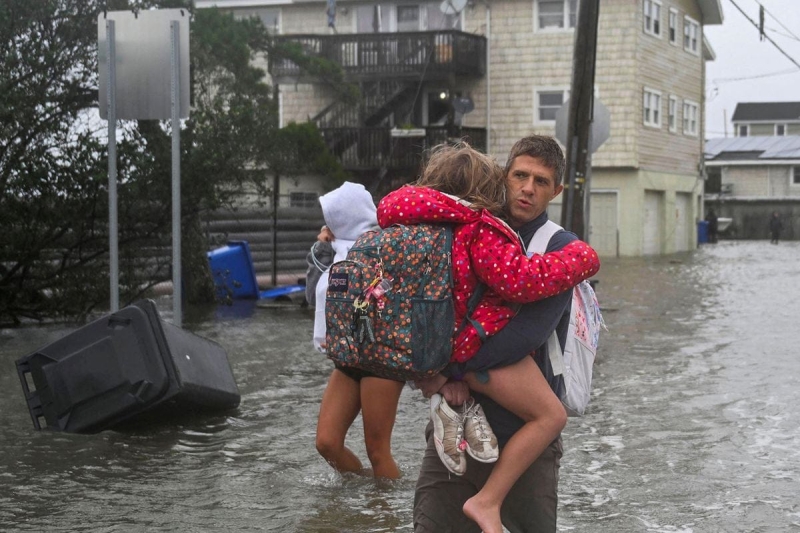
Severe storms have disrupted Thanksgiving holiday celebrations across the United States, bringing heavy rain and strong winds to the Midwest and Northeast, while powerful coastal surges have battered parts of the West Coast.
The extreme weather has disrupted daily life and transportation across several regions, with nearly one million households left without electricity and thousands of flights cancelled or delayed.
More than 80 million Americans were expected to travel this week. However, according to flight-tracking website FlightAware, more than 400 flights were cancelled across the country on Thursday, while another 2,200 domestic and international flights were delayed. The Federal Aviation Administration (FAA) had earlier warned that rain and strong winds could cause flight delays throughout the week.
By Thursday night, nearly one million households were without electricity, with Pennsylvania, Maryland and Virginia among the hardest-hit states.
The powerful storm that struck the eastern United States on Thursday brought destructive winds of up to 70 miles per hour, torrential rain and severe flooding in coastal areas.
Flooding in several communities along the Jersey Shore prompted New Jersey Governor Mikie Sherrill to declare a state of emergency. New York Governor Kathy Hochul also declared emergencies in New York City, Long Island and Westchester County.
Adverse weather conditions forced the annual Macy's Thanksgiving Day Parade in New York City to be postponed until Saturday. Bridges in Maryland were closed because of strong winds, while powerful waves flooded beaches in Delaware and pushed water onto boardwalks.
Meanwhile, a Maryland water utility urged nearly two million customers to use water only for essential purposes as disruptions to electricity supplies affected its operations.
According to the National Water Prediction Service, record rainfall in Washington, DC, on Thanksgiving Day, combined with high tides, caused tidal water to overflow and flood the runway at Ronald Reagan Washington National Airport.
By Thursday evening, more than 980,000 households had been reported without electricity, with Pennsylvania, Virginia, Maryland and New Jersey among the worst-affected states.
Pennsylvania Governor Josh Shapiro said power companies were working continuously to restore electricity. However, energy companies in Virginia and New Jersey warned that restoring power could take considerable time, potentially several days, as crews were unable to enter some affected areas until it was safe to do so.
On Thursday afternoon, President Donald Trump said he would consider releasing emergency funds for the East Coast to help deal with the holiday storm.
Meanwhile, adverse weather is also approaching the country's West Coast. The National Weather Service (NWS) has warned that a series of Pacific storms could bring heavy rain, mountain snowfall and strong winds.
Coastal communities are also facing the threat of flooding due to unusually high tides. The NWS said water levels in some parts of California's extensive coastline could exceed eight feet (2.4 metres) on Thursday, potentially breaking the highest levels recorded last month.
Earlier in the week, tides exceeding eight feet were recorded in both San Diego and Los Angeles. Visitors were advised to stay away from coastal areas.
Amtrak Pacific Surfliner, which operates along the California coast, said on social media that it had cancelled several train services because unusually high tides had created conditions that threatened to undermine railway tracks.
Storms have also been forecast for the Pacific Northwest, including Canada's British Columbia province.