

- Nine Killed in Landslides at Rohingya Camps |
- Govt Unveils Farm Reform Plan to Boost Food Security |
- England defeat Mexico 3-2 to reach World Cup quarter-finals |
- Haaland knocks Brazil out of World Cup as Norway reach quarters |
- A black poa fish sold for 50 thousand |
Nine Killed in Landslides at Rohingya Camps
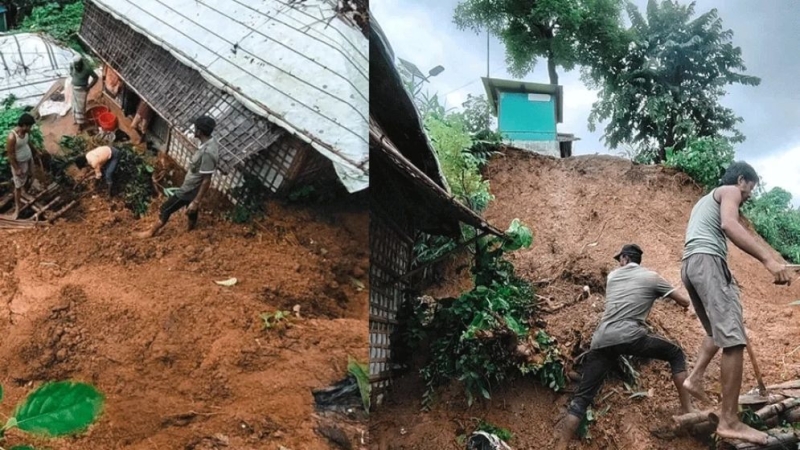
At least nine people, including women and children, were killed in a series of landslides triggered by heavy rainfall at Rohingya refugee camps in Ukhiya, Cox's Bazar, early Monday.
The first landslide struck at around 1:10am in Block D/6 of Jamtoli Camp-15 in Palongkhali Union, when a hillside collapsed onto the home of Rohingya refugee Mohammad Kamal Hossain, 44.
Rescue teams recovered the bodies of Kamal Hossain, his wife Humaira Begum, 39, and their four-year-old son Mohammad Anas from the debris.
Officials from the Fire Service and Civil Defence said firefighters launched rescue operations immediately after receiving the report.
While the operation was underway at Camp-15, authorities received reports of additional landslides at other camps. At Camp-11, local residents recovered the bodies of four victims before emergency responders reached the scene.
In another incident at around 1:45am, seven-year-old Rohingya boy Ekram died after being buried by soil from a hillside collapse in Block D/7 of Kutupalong Camp-7 in Rajapalong Union.
Camp officials identified the child as the son of Mohammad Rashid. Rohingya volunteers later recovered his body from the debris.
Later, at around 3:00am, camp authorities confirmed that four more people, including a woman and three children, were killed in another landslide in Block C/11 of Balukhali Camp-11. One other person was injured.
The victims were identified as Umme Habiba, 27, daughter of Abdur Razzak; her sister Tanzina Akter, 13; Mohammad Rihan, 5, son of Mohammad Rashid; and his three-year-old brother Harunur Rashid.
Local authorities warned that the threat of further landslides remains high as continuous rainfall continues to batter the district.
The upazila administration has been making repeated announcements through loudspeakers, urging residents living in vulnerable hillside areas to move to safer locations.
According to the Bangladesh Meteorological Department, more than 100 millimetres of rainfall has been recorded in Cox's Bazar over the past 24 hours.
Meteorologists attributed the heavy rain to a well-marked low-pressure system over the Bay of Bengal coupled with an active monsoon, warning that adverse weather conditions are likely to persist for at least two more days.