

- Can Dhaka’s arms recovery drive ensure peaceful polls? |
- ‘Unhealthy’ air quality recorded in Dhaka Monday morning |
- BD peacekeepers' deaths: UN chief calls Dr. Yunus, offers condolence |
- Bangladesh Plans Rockets, Satellites, and Space Industrial Park |
- India willing to work together inspired by shared sacrifices of past |
Dialogue Is Necessary as Global Divisions Deepen: UN Forum
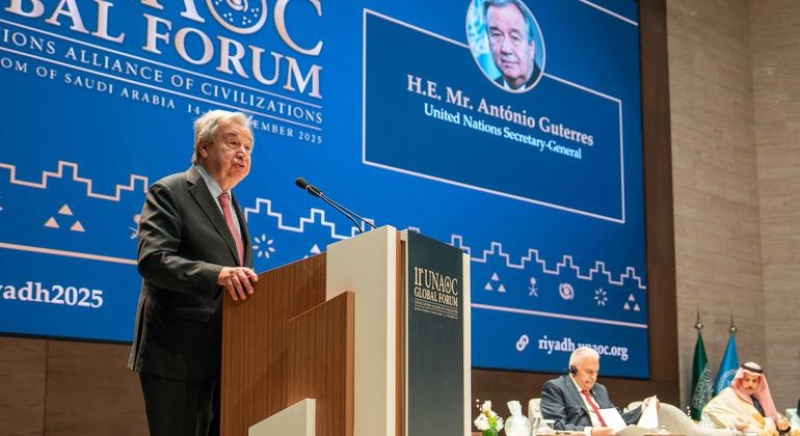
UN Secretary-General António Guterres delivers remarks to the opening of the 11th UN Alliance of Civilizations Global Forum, in Riyadh, Saudi Arabia.
The 11th Global Forum of the UN Alliance of Civilizations opened in Riyadh on Sunday with a blunt message for a world riven by distrust: dialogue is not a luxury—it is a survival strategy.
Over the next two days, participants gathered in the Saudi capital are expected to stress that cooperation across cultures, religions and communities remains the only viable way to navigate an era marked by rising polarisation and conflict.
Speaking at the opening session, UN Secretary-General António Guterres rejected claims that the Alliance’s mission is unrealistic or, as critics argue, “too soft for our hard world.”
Those who dismiss dialogue as naïve, he warned, are mistaken. Diplomacy and cooperation, he said, are not optional; they are essential.
Two decades have passed since then Secretary-General Kofi Annan launched the initiative in 2005 with support from Spain and Türkiye. While the geopolitical landscape has changed dramatically, the Alliance’s core purpose remains unchanged: countering extremism and intolerance and helping societies of different cultures and faiths live together in dignity.
The UN chief described the paradox of an age in which humanity is “more connected, yet never more fragmented,” and outlined two possible futures—one defined by fear, walls and escalating wars, and another built on bridges between cultures.
Only the second path, he stressed, leads to sustainable peace. “No more 7th of Octobers. No more Gazas destroyed. No more El-Fashers starved. No more communities massacred, expelled or scapegoated.”
Guterres identified three forces capable of driving positive global change: young people, women and girls, and people of faith. He urged delegates to advance the Alliance’s mission “with courage, clarity and hope.”
Countries participating in the forum endorsed the Riyadh Communiqué, which calls for combating all forms of religious intolerance as a global priority. The document underscores the role of education in fostering dialogue, human rights and peaceful societies, and reaffirms the Alliance’s founding aim of strengthening cooperation among cultures and religions while promoting respect, mutual understanding and inclusion.
UNAOC High Representative Miguel Moratinos stressed that every culture must have an equal voice in shaping the world’s future. No single perspective should dominate, he said, adding that a peaceful and inclusive global community must draw on the wisdom of all civilizations.
Warning of a “return of hatred,” Moratinos urged vigilance against growing discrimination. Quoting a verse from the Qur’an’s Surah Al-Hujurat, he said human diversity is a source of strength, not division. He underscored that Islam is a religion of peace and said Islamophobia must have no place anywhere, while also stressing that antisemitism must be eradicated and that legitimate criticism of governments should not be used to demonise entire communities.
Saudi Arabia’s Foreign Minister Prince Faisal bin Farhan Al Saud reaffirmed the Kingdom’s commitment to intercultural dialogue, saying engagement among cultures and civilizations is essential for peace, cooperation and conflict prevention. He warned of the growing spread of extremist movements and the rise in hate speech and Islamophobia, urging nations to reinforce—rather than abandon—the values of dialogue and coexistence.
The opening day also focused on AI-driven misinformation. Speakers warned that deepfakes, algorithm-amplified hate speech and weak regulation are reshaping public debate.
Ismail Serageldin, co-chair of the Nizami Ganjavi International Center, said artificial intelligence is unavoidable but should not be feared. With proper safeguards, he said, AI could enhance productivity and work-life balance, stressing that smart regulation must protect the public without stifling innovation.
Others cautioned that AI is accelerating the spread of hate speech and blurring the line between real content and deepfakes. They called for clear rules, responsible deployment and greater involvement of policymakers, journalists and young people to ensure that emerging technologies serve humanity and uphold shared human values.