

- Net FDI in Bangladesh jumps 39.36% to $1.77 billion in 2025 |
- Bangladesh, US sign energy cooperation MoU in Washington |
- UNAIDS Warns HIV Services Face Crisis Amid Funding Cuts |
- Central Bank approves liquidation of 5 ailing NBFIs from July |
- Trump seeks Chinese support for possible Iran deal |
US-Bangladesh ties growing: US Counselor
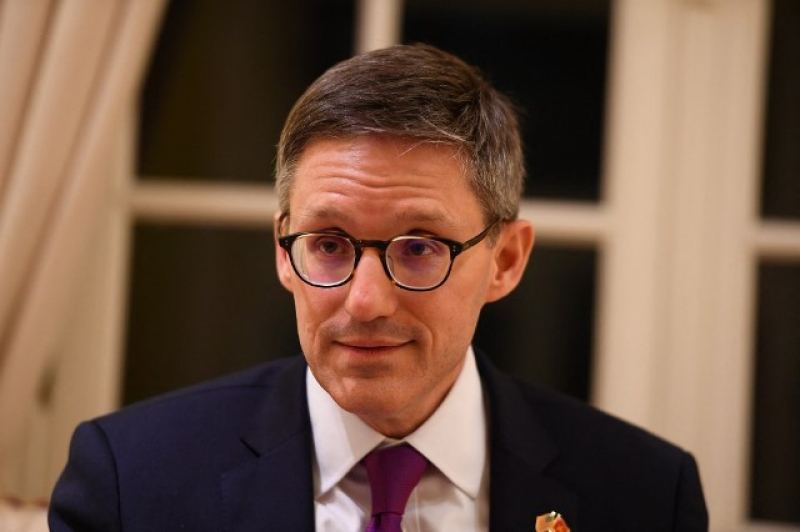
Derek Chollett, Counselor of the US Department of State
Visiting US State Department’s Counselor Derek Chollet said on Wednesday that his country sees ‘huge potential’ in its ties with Bangladesh. There is a lot of ‘room to grow,’ he said.
‘We are keen to follow up, it is a remarkable journey of 51 years,’ he said.
He said US-Bangladesh ties were growing politically, economically and in the sphere of security.
"The US places considerable importance on its relationship with Bangladesh, as we remain “hopeful” about our future strong partnership that we developed over the last 51 years," Chollet told the reporters at a at the Foreign Ministry.
On the Rohingya issue, he said they are continuously working and trying to help Bangladesh.
He said he met senior officials in Bangladesh to discuss “coordination and response” to the Rohingya refugee crisis, strengthening cooperation in international forums and advancing the “security partnership” between Dhaka and Washington.
The US sees “huge potential” in relationship with Bangladesh and a lot of “room to grow”, he added.
“We are deeply concerned about the situation in Myanmar which is only getting worse,” Chollet said before he arrived in Dhaka.
He they are doing whatever they can to cooperate with Bangladesh and trying to ease the pressure on the country from the refugee crisis by providing critical assistance to support its humanitarian need million Rohingyas, and also trying to deal with the root cause of the crisis in Myanmar.
Taking part in the briefing, Foreign Minister Dr AK Abdul Momen said, “We had a very good discussion. I am very happy. We are looking forward to better days,” he said.
He said the US will be with Bangladesh in dealing with the Rohingya crisis.
Chollet and his delegation members met Prime Minister Sheikh Hasina at Ganabhaban.
‘We are interested in deepening the ties,’ he told TV talk show ‘Tritiyo Matra’ online before his visit to Bangladesh on February 14 to discuss ways to deepen cooperation between the two countries with senior officials and the private sector.
Reiterating that the US ‘places democracy and human rights at the heart of its foreign policy, Chollet said that Bangladesh was a good long-standing friend.
He said that he had ‘very frank exchanges’ about the concerns of the US.
He said that the US acknowledged that no democracy was perfect but they always tried to make themselves better and tried to acknowledge their mistakes to improve.
He said that he discussed freedom of press, free and fair elections or the ability of civil society to organise and express their views freely, in the ‘spirit of partnership and friendship’.
‘We look forward to continue working closely with the government of Bangladesh,’ Chollet said, adding that being a strong democracy was vital for a country to be successful.
He said that democracy was learning from one another and that the US looked forward to continue working with Bangladesh as they would try to make their democracies stronger.
About the next general election in Bangladesh, Chollet said that his country wants elections to be free and fair in any of their democratic friends.
He appreciated peaceful rallies held last year in Bangladesh and said that was a good thing.
The issues related to the Rohingya crisis and overall security in Indo-Pacific region are likely to get priority during his visit, he said.
‘We are deeply concerned about the situation in Myanmar which is only getting worse,’ said Chollet.
The US want solution to the Rohingya crisis and solution lies in Myanmar but instability is growing inside Myanmar, he said.
He said that the US was doing whatever it could in cooperation with Bangladesh to try to ease the pressure of Rohingyas on Bangladesh by providing critical assistance to it to support its humanitarian needs, also with efforts to try to bring some of the refugees to the US.
The vibrancy of Bangladesh economy encourages the US to have a ‘deeper cooperation’ with Bangladesh, he said.
He said that he would try to promote common interest – economic ties, diplomatically and will explore what the two sides could do to improve their security relations and work together for addressing shared challenges – regionally, in Myanmar and globally on climate change.
There are ‘whole host of issues’ that the two countries could work together, he said.
Highlighting the importance of cooperation in the Indo-Pacific region, Chollet said that Bangladesh was an important partner and that was why a steady stream of high-level visits took place in Bangladesh.
The Indo-Pacific Strategy of the US outlines President Joe Biden’s vision to more firmly anchor the country in the Indo-Pacific and strengthen the region in the process. Its central focus is a sustained and creative collaboration with allies, partners, and institutions, within the region and beyond it, he added.
‘Counsellor Derek Chollet will be visiting Bangladesh. The purpose of his visit is to strengthen the bilateral relations between Bangladesh and the United States,’ the Ministry of Foreign Affairs spokesperson Seheli Sabrin told reporters in Dhaka.
The US counselor holds the rank of undersecretary as a senior policy advisor to the US secretary of state on a wide range of issues and conducts special diplomatic assignments as directed by the secretary.
Sabrin said that Chollet would also discuss the Rohingya issue and see the situation on the ground. Bangladesh is hosting over 1.1 million Rohingyas in Cox’s Bazar and Bhasan Char.
‘The programmes are yet to be finalised,’ she said about Chollet’s planned February 14-15 visit.
Chollet previously held positions at the state department, the White House, and the Department of Defence.
During 2012-2015, as the US assistant secretary of defence for international security affairs, he managed US defence policy towards Europe, the Middle East, Africa, and the Western Hemisphere.
Before joining the Pentagon, Chollet served at the White House as special assistant to the President and senior director for strategic planning on the National Security Council staff.
From 2009 to 2011, he was the principal deputy director of the state department’s policy planning staff.
He served on the 2020 Biden-Harris state department transition team as well as in the 2008 Obama-Biden NSC transition team.
jehangirh01@gmail.com