

- Bangladesh sees 31 risky heat days, 25 for CC, this summer |
- ECNEC Approves Three Metro Rail Projects Worth Tk2.5tn |
- Rising violence triggers UNSC emergency meeting on Yemen |
- Gaza remains recovery points to possible war crimes: Volker Turk |
JS Speaker stresses Bangladesh-Germany parliamentary ties
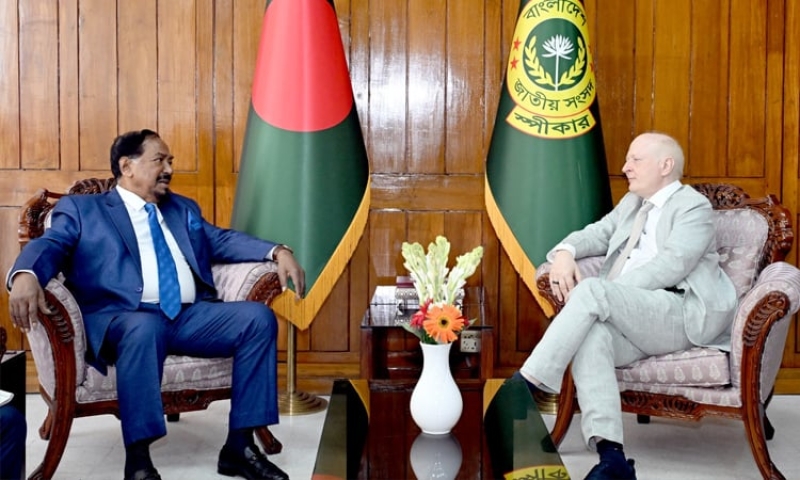
Bangladesh and Germany are long-standing friendly countries, and the presence of German observers in Bangladesh's latest parliamentary election has further strengthened the existing ties between the two countries, Bangladesh Jatiya Sangsad Speaker Hafiz Uddin Ahmad, Bir Bikrom, said today.
"Both Germany and Bangladesh are fraternal countries in the democratic sphere," he said when German Ambassador to Bangladesh Dr Rüdiger Lotz paid a courtesy call on him at his office here.
The Speaker said Bangladesh had faced prolonged exploitation and experienced severe democratic discrimination during the Pakistan period.
Although the country attained independence through the Liberation War in 1971, its democratic transition was repeatedly disrupted, he said.
"People became frustrated with 15 years of misrule by the Awami League. A mass uprising of students and people took place against enforced disappearances, killings, extrajudicial killings and farcical elections," Hafiz Uddin said.
He said democracy had been restored in the country through an acceptable and neutral election in the wake of the mass uprising, said a press release of parliament secretariat.
The Speaker said the people of Bangladesh had repeatedly sacrificed themselves for democracy and had never deviated from their long struggle to establish the rule of law.
German Ambassador Dr Rüdiger Lotz said Bangladesh had moved from authoritarian rule towards democracy after being freed from 15 years of authoritarian governance.
He said the elected government currently faces many challenges and pledged the German government's highest possible support to make democracy effective in Bangladesh.
During the meeting, the delegation stressed the formation of a Germany-Bangladesh parliamentary committee and expansion of parliamentary diplomacy through friendship groups.
They also emphasised increasing German economic investment in Bangladesh, particularly exploration for oil and gas wells in coastal areas and the establishment of fertiliser factories.
The Speaker invited German experts to explore oil and gas resources in Bangladesh's maritime boundary and coastal areas.
He informed the ambassador that Bangladesh's future economy would depend on energy.
Representatives of the German Embassy and relevant officials of the Bangladesh Parliament Secretariat were present at the meeting, reports BSS.