

- BNP govt solved Rohingya crisis twice before, will do so again: FM |
- Venezuela earthquakes kill 920, tens of thousands missing |
- Search Continues After Venezuela Quakes Kill 235 |
- Dhaka, Beijing sign 13 MoUs to deepen cooperation across key areas |
- China Eyes Teesta Project, Trade Boost With Bangladesh |
Dhaka, Beijing to explore 2+2 dialogue in diplomacy, defence: FM
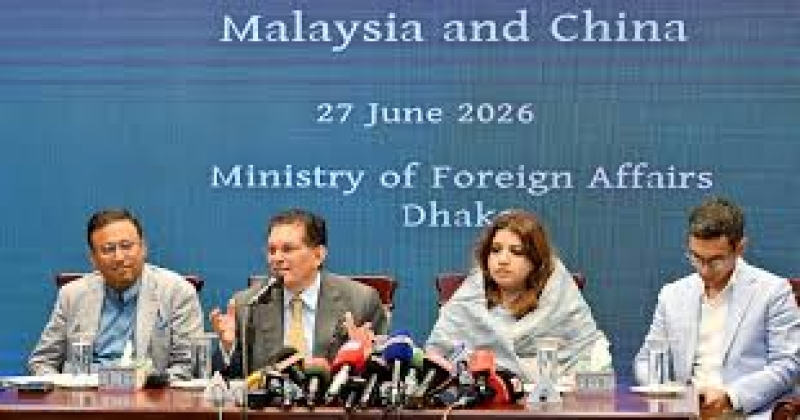
Highlighting the major success of Prime Minister Tarique Rahman’s just-concluded visit to China, Foreign Minister Dr Khalilur Rahman on Saturday said Bangladesh's relations with China have been elevated from a "Comprehensive Strategic Cooperative Partnership" to a "Bangladesh-China Community with a Shared Future"- the highest level of bilateral cooperation.
“This is the highest step in terms of China's bilateral engagement,” he told reporters at the Ministry of Foreign Affairs while outlining the achievements of the Prime Minister’s twin visits to Malaysia and China.
He said the photos and videos from the Prime Minister’s visits to Malaysia and China reflected Bangladesh’s growing importance and underscored the strengthening of Dhaka’s relations with Kuala Lumpur and Beijing.
State Minister for Foreign Affairs Shama Obaed Islam, Prime Minister’s Adviser on Foreign Affairs Humaiun Kobir, BIDA Executive Chairman Ashik Chowdhury, Foreign Secretary Asad Alam Siam, and senior officials of the Ministry of Foreign Affairs were present at the media briefing.
Adviser Humaiun Kobir said the two sides signed a Memorandum of Understanding (MoU) at the party-to-party level to establish a formal partnership aimed at strengthening political cooperation.
Among the key achievements of the Prime Minister's visit to China are the launch of a strategic dialogue at the foreign minister level and the exploration of a "2+2" dialogue mechanism covering diplomacy and defence.
"We have not taken any decision yet (regarding "2+2" dialogue mechanism). It's still at the exploration stage...we will explore it," said Foreign Minister Dr Khalilur while responding to a question.
The "2+2" dialogue mechanism, typically a high-level format involving the foreign and defence ministers of both countries, was once a signature diplomatic tool of Western nations but is now actively utilised by China to strengthen strategic partnerships. Beijing uses this framework to deepen regional security cooperation, safeguard political systems, and coordinate diplomatic responses to external pressures.
Bangladesh and China signed 17 bilateral instruments, including MoUs, agreements, a joint action plan, and an agricultural trade protocol, to further strengthen bilateral relations.
The two sides signed an MoU on promoting the implementation of the Global Development Initiative (GDI).
Another MoU on exchanges and cooperation between the Bangladesh Nationalist Party (BNP) and the Communist Party of China was also signed.
The GDI focuses on humanity’s shared development needs, aligns closely with the United Nations 2030 Agenda for Sustainable Development, and addresses key global development challenges.
The other signed documents include: an agreement on development cooperation between Bangladesh and China; an agreement on the expansion and modernisation of the Mongla Port Facilities Project; an MoU on the joint implementation of the 2026 Human Resources Development Cooperation Programme; an agricultural trade protocol on phytosanitary requirements for the export of fresh jackfruit from Bangladesh to China; a memorandum on deepening cooperation between China Media Group (CMG) and Bangladesh Television (BTV); an MoU between CMG and the Ministry of Information and Broadcasting of Bangladesh; an MoU between Xinhua News Agency and Bangladesh Sangbad Sangstha (BSS); an MoU between Xinhua News Agency and the Ministry of Information and Broadcasting; an agreement on cooperation in Chinese language education; an MoU on strengthening cooperation in vocational education; an MoU on promoting investment cooperation in green development; an export promotion joint action plan to enhance Bangladesh’s export capacity; an industrial development and land lease agreement for the Chattogram Economic Industrial Zone (CEIZ); an MoU on cooperation for the development of the China-Bangladesh Mongla Port Economic Zone; and an investment cooperation agreement with the China Council for the Promotion of International Trade (CCPIT).
The leaders of the two countries agreed to build a China-Bangladesh Community with a Shared Future in the new era.
Bangladesh and China also agreed to deepen cooperation in integrated water resources management, water resources planning, hydrological forecasting, flood prevention and disaster reduction, river dredging, and related technology sharing.
Prime Minister Tarique Rahman returned home from Beijing on Friday after wrapping up his first overseas tour, which included visits to Malaysia and China.
The Prime Minister attended the 17th Annual Meeting of the New Champions of the World Economic Forum (WEF), also known as the Summer Davos, in Dalian, China, as a leader representing emerging economies.
Bangladesh is playing a leading role in addressing global climate change challenges, and in recognition of this role, the Prime Minister was invited to deliver a keynote address on the issue at the forum.
During the bilateral visit to Beijing, the two countries agreed to expedite the implementation of the Mongla Port Modernisation and Expansion Project and the Chinese Economic and Industrial Zone Development Project in Chattogram.
They also agreed to cooperate on both large and small public welfare projects under the Belt and Road Initiative (BRI).
The two sides discussed proposals to strengthen regional connectivity, particularly multimodal transport links from Kunming to Bangladeshi ports, as well as China’s proposal for the China-Bangladesh-Myanmar Economic Corridor.
Bangladesh also sees significant progress in the Teesta River Comprehensive Management and Restoration Project (TRCMRP). China reaffirmed that it would provide all possible assistance, and both sides agreed to accelerate the project's feasibility study.
In addition, the two countries agreed to deepen cooperation in integrated water resources management, flood prevention, river dredging, related technology exchange, and defence cooperation, reports UNB.