

- Govt to Build Ganga, Teesta Barrages for Water Security |
- Bangladesh Warned Repeatedly Over Measles Vaccine Gap |
- 163 Olive Ridley turtle hatchlings found on Kuakata beach |
Germany keen to deepen ties with Bangladesh in strategic sectors
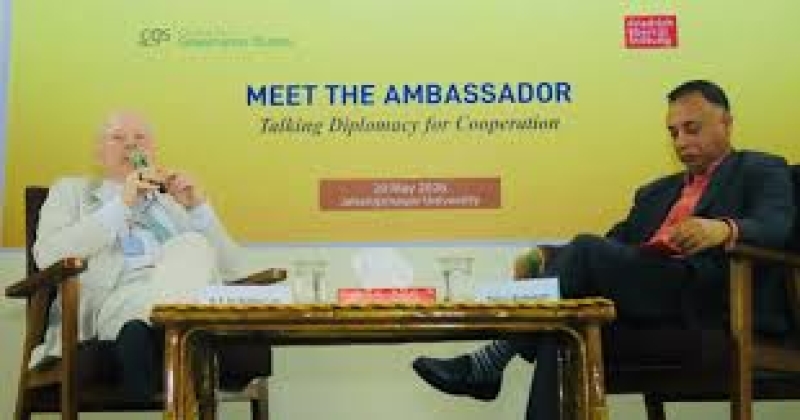
German Ambassador to Bangladesh Dr Rüdiger Lotz on Wednesday expressed Germany’s strong interest in expanding collaboration with Bangladesh in strategic sectors, including technology, skilled manpower, renewable energy, research and innovation-driven industries.
“Germany is currently one of Bangladesh’s largest export destinations and an important trade partner in Europe. Beyond the ready-made garment sector, there are significant opportunities to expand cooperation in technology, skilled human resources, renewable energy, research, and innovation-based industries,” he said.
The Ambassador made the remarks while speaking at the second session of the “Meet the Ambassador” series held at the Senate Hall of Jahangirnagar University.
The event organised by the Centre for Governance Studies (CGS), in collaboration with the Friedrich-Ebert-Stiftung (FES) Bangladesh, brought together diplomats, academics, political leaders, students, researchers, and media professionals.
Discussions focused on Bangladesh-Germany relations, academic cooperation, youth engagement, and areas of mutual interest.
Rüdiger Lotz further stated that the world is entering a multipolar international order, where dialogue and cooperation between states are becoming increasingly important. In this context, Bangladesh and Germany both value democratic principles, international cooperation, and dialogue-based engagement.
He emphasised that people-to-people contact, education, and skills development will further strengthen bilateral relations in the future.
Expressing his pleasure at visiting Jahangirnagar University, the Ambassador said the campus was highly inspiring and vibrant. He noted that today’s students will become the future leaders of Bangladesh – as diplomats, policymakers, researchers, and development professionals – and therefore must develop skills, knowledge, and a strong sense of responsibility.
He also highlighted Germany’s cooperation with Bangladesh in areas such as climate change mitigation, renewable energy, labour rights, skills development, technical training, and good governance. He added that Germany continues to provide humanitarian support in addressing the Rohingya crisis.
During the question-and-answer session, moderator CGS President Zillur Rahman raised key issues, including bilateral relations, trade, higher education, skills development, migration, climate change, and the Rohingya crisis.
Responding to a question on the future of Bangladesh-Germany relations, Rüdiger Lotz said there is significant potential for further strengthening ties. He noted that Germany is already playing an important role in trade, investment, skills development, climate cooperation, and higher education, and that future cooperation could expand further in technology transfer, industrial diversification, and human resource development.
On the issue of visa delays for Bangladeshi students applying for higher education in Germany, he explained that there is currently a large backlog of applications – around 60,000 cases under process.
The Ambassador noted that many applicants apply multiple times and that each application requires thorough verification of documents. In some cases, false or inaccurate documentation is also identified, requiring additional scrutiny and time-consuming evaluation.
He further stated that in some instances, students attempt to enter the labour market instead of pursuing studies, which also requires careful assessment by visa authorities. However, he expressed optimism that once the backlog is reduced, visa processing time will improve significantly.
Rüdiger Lotz reaffirmed Germany’s interest in welcoming more Bangladeshi students for higher education.
JU Vice Chancellor Prof Dr Md Kamrul Ahsan said initiatives like the “Meet the Ambassador” provide students with valuable opportunities to understand global politics, higher education, and international cooperation.
FES Bangladesh Resident Representative Dr Felix Gerdes emphasised that such dialogues help young people better understand global politics, diplomacy, and international relations, reports UNB.