

- Boishakhi storm destroys 5 houses, damages over 50 in Kalapara |
- ‘Everyone is crushing me with love’: Dr. Shafiqur sparks laughter in JS |
- Nor’wester lashes Khagrachhari; road links to Dhaka, Ctg cut off |
- Bangladesh Begins Nuclear Power Era With Fuel Loading |
- With Canal Digging Tarique Revives Zia's Legacy |
BD committed to buy $3.5bn US agril products: Ambassador
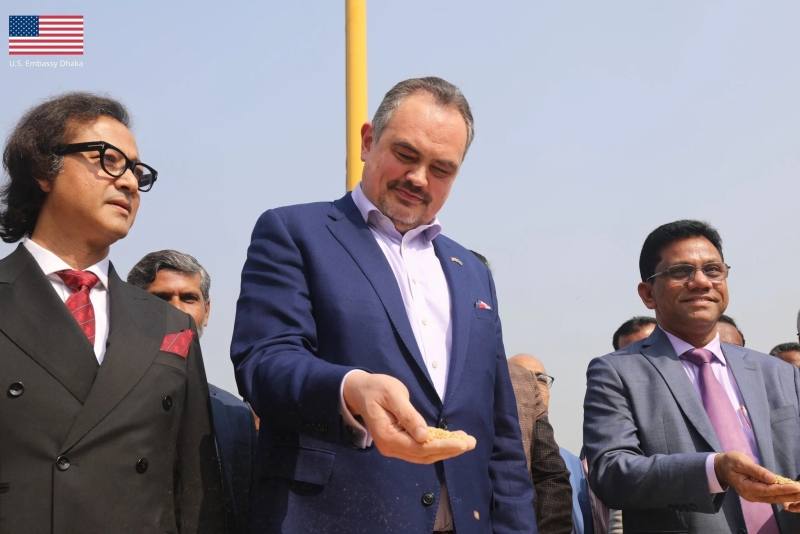
Brent T. Christensen, US Ambassador to visited Chattogram recently
Dhaka, April 28 - US Ambassador to Bangladesh Brent T. Christensen on Tuesday described the agreement on reciprocal trade (ART) as an excellent agreement, noting that Bangladesh has committed to purchasing $3.5 billion in US agricultural products - wheat, soy, cotton, and corn.
The recently concluded agreement on reciprocal trade, the Ambassador said, can propel not just trade between the two countries, but Bangladesh’s economic development to new levels if fully embraced and executed.
“The ART is an excellent agreement, which preserves Bangladesh’s access to the critical US market with competitive 19 percent tariffs – down from 35 percent without the agreement -- while making changes in Bangladesh’s tariffs and non-tariff trade barriers designed to encourage imports from the United States to balance our trade. This is really just common sense,” he said while speaking at a luncheon meeting.
The American Chamber of Commerce in Bangladesh (AmCham) hosted the luncheon meeting titled, “Advancing US-Bangladesh Economic Partnership” at a city hotel.
Commerce Minister Khandakar Abdul Muktadir spoke as the chief guest while the US envoy attended as special guest, underscoring the importance of Bangladesh-United States economic engagement.
The luncheon was presided over by AmCham President Syed Ershad Ahmed, alongside members of the AmCham Executive Committee.
The event also included senior representatives from the Ministry, members of the diplomatic corps, officials from regulatory authorities, leading business figures, AmCham members, and other guests reflecting a broad and influential cross-section of stakeholders engaged in Bangladesh’s economic and trade landscape.
The Commerce Minister emphasised strengthening economic ties through export diversification, expanded market access and increased investment flows.
He said the government is prioritising sectors such as pharmaceuticals, leather goods, agricultural products, light engineering and ICT to broaden the export base.
The Commerce Minister sought continued US support for Bangladesh's smooth graduation from least developed country (LDC) status, noting that Dhaka has proposed extending the transition period and is targeting November 2029 for graduation.
AmCham President Syed Ershad Ahmed highlighted the role of the American Chamber of Commerce in Bangladesh in strengthening Bangladesh–United States trade relations and noted the significant growth in bilateral trade over the years.
He emphasised the importance of sustaining this partnership amid a changing global landscape, while also underscoring AmCham’s commitment to promoting responsible business practices and supporting a conducive environment for trade and investment
Enormous Trade Potential
Ambassador Christensen said this moment is one of extraordinary opportunities for Bangladesh. “With a population of over 170 million people, one of the most dynamic (and youngest) workforces in the region, and a strategic location in South Asia, Bangladesh has tremendous potential to become a major manufacturing center in the 21st century,” he said.
The envoy said they cannot have lasting economic prosperity if those countries that export to the United States then import primarily from other countries – creating massive and chronic trade deficits that impoverish the very market you rely on.
“If you are going to sell to us, you need to make an effort to buy from us. And at the very least, not impose massive tariffs and arcane and even absurd non-tariff trade barriers like radiation tests of our wheat and tests for pesticide we don’t use, together with total tax incidence on our exports of up to 150 percent,” he said.
The Ambassador said the press and pundits like to focus on the price, but experts focus on things like quality and protein content. “You get what you pay for.”
The agreement also commits Bangladesh to $15 billion in energy products over the next 15 years, something that would be met by simply continuing the current rate of LPG from the US, he said.
Given the role of the US as one of the largest and most reliable suppliers of energy in the world, he said this seems like a commitment that will likely be surpassed by market forces alone, while improving availability of energy across Bangladesh.
“These aren't aid packages; these are commercial deals that create jobs and opportunities in both our countries,” Christensen said.
Besides these direct purchase agreements, he said the Bangladeshi government has also made commitments in the ART to improve the business climate - commitments that should be applauded by every Bangladeshi businessman, politician, and consumer.
“This is about Bangladesh unlocking its potential. It's not a secret Bangladesh has long been a very tough place to do business. You all live this every day,” the US envoy said.
He said the ART is not a list of demands from the United States but it is a shared commitment to Bangladesh’s future.
“The United States is excited about this country’s future, and the ART provides a vision for an incredible future for both of our countries,” he said.
What Success Requires
The envoy said the foundation of successful commercial relationships is trust, and trust requires that contracts be honored.
He said American companies need confidence that agreements with Bangladesh companies and the government will be respected and implemented consistently. “When contracts are honored, investment flows. When they're not, investors look elsewhere.”
The envoy said investors need predictability and they need to know that the rules today will be the rules tomorrow. “They can’t face unfair tax burdens or blocks on the movement of capital and data."
He highlighted the importance of streamlining business registration and licensing; digitalizing customs procedures; ensuring regulatory decisions are based on objective criteria; protecting intellectual property rights; enforcing labor and environmental standards that meet international norms.
“Our agreement commits Bangladesh to important reforms, including prohibiting imports of goods made with forced labor and strengthening labor law enforcement,” the US envoy said. “These aren't just American demands; they're the standards that will make Bangladesh more competitive globally.”
Highlighting what makes the United States the best long-term commercial partner for Bangladesh, the Ambassador said they believe in transparency and fairness; bring cutting-edge technology; and focus on building capacity.
Power for the Future
The envoy said Bangladesh needs significant energy sector investment, an estimated $180 billion by 2050, to meet growing demand and power economic growth.
He said American energy companies are already key economic partners for Bangladesh. Chevron provides half of Bangladesh's natural gas supply – and is ready to produce more.
The envoy said Excelerate Energy facilitates the import of an additional third via LNG - and wants to bring in more.
“The United States is now the world's largest exporter of liquefied natural gas, and we're ready to help Bangladesh diversify its energy sources further, build reliable and affordable energy infrastructure, and provide America’s unmatched technology and expertise in all types of energy including advanced nuclear power,” he said.
The United States, the envoy said, is partnering with Bangladesh to meet today’s energy demands. “We are ready to help build energy security and power Bangladesh's industrial future for many years to come.” - UNB