

- Kuakata's 'Mini Switzerland', 'Lal Kakrar Char' captivating tourists |
- Democratization of economy Govt’s core objective: Amir Khasru |
- OIC Condemns Terrorist Attack in Bannu District of Pakistan |
- Pakistan, India, both celebrate victory a year after war |
- Iran sends response to US peace proposal via Pakistan |
Tk 33,474cr Padma Barrage Project Awaits Approval
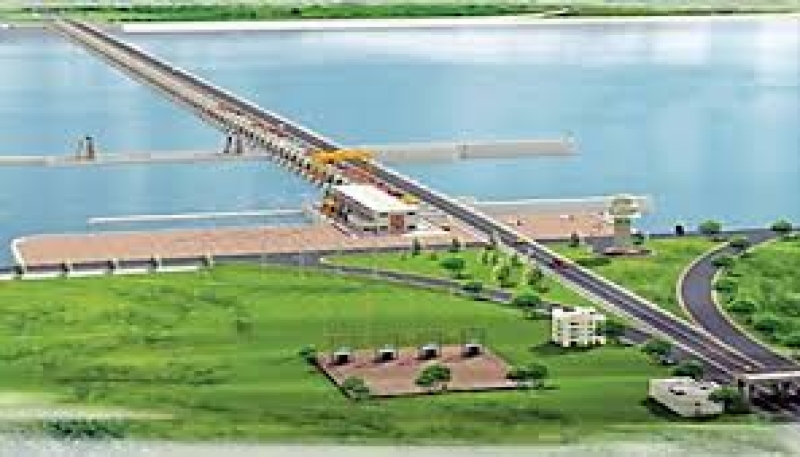
The government is set to move forward with the long-discussed Padma Barrage project, a mega water management initiative expected to transform irrigation, agriculture and river flow across Bangladesh’s southwest region.
The proposed first phase of the project, estimated to cost Tk 33,474 crore, is likely to be placed before the Executive Committee of the National Economic Council (ECNEC) for approval at its meeting on Wednesday.
If approved, the project will mark a major step in addressing decades of dry-season water shortages linked to reduced water flow in the Padma River, particularly after the construction of India’s Farakka Barrage upstream.
Officials involved with the project say the initiative is expected to revive dying rivers, reduce salinity in the southwest, increase crop and fish production, improve biodiversity and ensure year-round freshwater supply to millions of people.
Under the proposal, a 2.1-kilometre-long barrage will be constructed on the Padma River in Pangsha upazila of Rajbari district. The structure will include 78 spillways, 18 under-sluices and two fish passes to maintain aquatic movement and ecological balance.
The barrage will be capable of storing around 2.9 billion cubic metres of water. Authorities also plan to build three major offtake structures to distribute the stored water to different regions.
In addition, a 113-megawatt hydropower plant will be established under the project, adding renewable electricity generation to the country’s energy mix.
According to project documents, the stored water will help restore the flow of at least five major rivers during the dry season — the Hisna-Mathabhanga, Gorai-Madhumati, Chandana-Barasia, Baral and Ichamati rivers.
These rivers, once vibrant lifelines for agriculture, fisheries and river transport, have gradually lost navigability and water flow over the years, affecting the livelihoods of millions in the southwest region.
For farmers in districts such as Kushtia, Rajshahi, Pabna, Faridpur, Jashore, Khulna and Barishal, the project carries enormous expectations.
Officials estimate that irrigation facilities from the barrage could support nearly 2.9 million hectares of cultivable land, potentially increasing annual rice production by around 2.4 million tonnes and fish production by over 2.3 million tonnes.
Experts say the project could significantly change life in drought-prone and salinity-affected areas where many farmers struggle every dry season to secure freshwater for crops and household use.
Communities in the southwest have long complained about shrinking rivers, rising temperatures, falling groundwater levels and increasing salinity intrusion from the Bay of Bengal.
Residents in several districts also face growing waterlogging problems due to silt accumulation and inadequate freshwater flow.
Project planners believe regulated water supply from the Padma Barrage could help ease many of these long-standing environmental and economic challenges.
According to government estimates, the project may generate nearly Tk 8,000 crore in annual economic and social benefits once fully operational.
The implementation period for the first phase has been proposed from 2026 to 2033.
Planning ministry officials said the project is also linked to the government’s broader commitment to strengthening water security and boosting agricultural resilience amid climate change.
Water resource experts say the concept of the Padma Barrage is not new. Discussions on such a structure date back to the 1960s, while serious feasibility studies and design work were conducted over the past two decades.
Environmental and water resources expert Ainun Nishat, who was previously associated with the initiative, said the project has long been considered important for Bangladesh’s future water management.
He noted that declining dry-season flow in the Padma and connected rivers has severely affected ecosystems, agriculture and local economies over the years.
Researchers from the Institute of Water and Flood Management at Bangladesh University of Engineering and Technology (BUET) also stressed the urgency of increasing freshwater retention and distribution capacity in the face of climate change and rising salinity.
Experts, however, cautioned that financing, environmental management and proper implementation would be key challenges for the mega project.
Still, for many farmers and residents in Bangladesh’s southwest, the proposed barrage represents more than a large infrastructure project. It symbolizes hope for reliable water, revived rivers and a more secure future for communities that have battled water scarcity for decades.