

- SSC and Equivalent Exams Begin Nationwide |
- US, Iran Signal War Readiness as Talks Hang in Balance |
- Bangladesh, EU Push for FTA, Investment Pact Talks |
- Over 1.14cr workers sent to Middle East in 22 years |
- BNP finalizes 36 nominations for women’s seats in Parliament |
Israel Hits Lebanon with Deadliest Strikes, 90 Killed
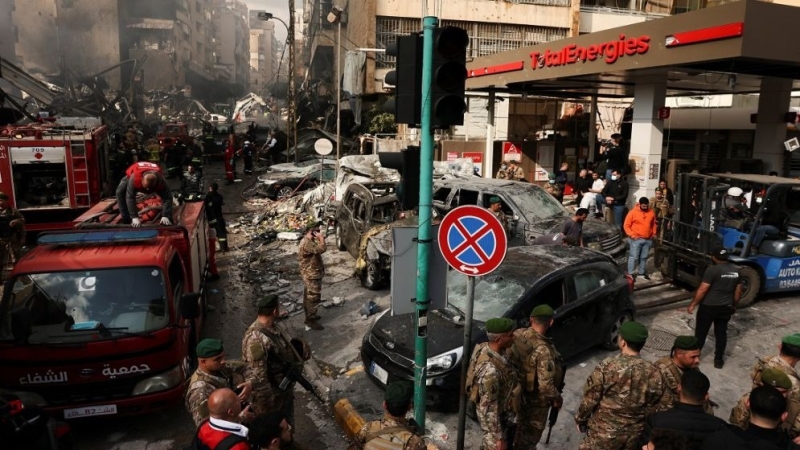
Soldiers stand at the site of an Israeli strike, in Al-Mazraa in Beirut, Lebanon, 8 April 2026.
Israel launched its heaviest strikes on Lebanon since the conflict with Hezbollah began last month, even as the Iran-aligned group paused attacks under a US-Iran ceasefire.
The attacks killed nearly 90 people and wounded around 800 across the country. Consecutive explosions shook Beirut, sending smoke across the capital, as Israel’s military said it targeted more than 100 Hezbollah command centres and military sites in Beirut, the Bekaa Valley, and southern Lebanon.
Lebanon’s health ministry confirmed dozens of deaths and hundreds of injuries. In Beirut, residents abandoned cars in traffic to reach hospitals.
Israeli Prime Minister Benjamin Netanyahu said the US-Iran ceasefire did not cover Lebanon. Israeli forces vowed to continue operations against Hezbollah. “The battle in Lebanon continues, and the ceasefire does not include Lebanon,” military spokesperson Avichay Adraee said. Defence Minister Israel Katz described the strikes as the largest concentrated blow to Hezbollah since a September 2024 operation.
This contradicted remarks by Pakistani Prime Minister Shehbaz Sharif, a key mediator in the US-Iran truce, who had indicated Lebanon would be included.
Lebanon’s state news agency reported ongoing air and artillery strikes in southern regions. A dawn airstrike near a hospital killed four, while a strike on Sidon killed eight and wounded 22, according to the health ministry. Hezbollah halted attacks on Israeli targets early Wednesday but is expected to release a formal statement on the ceasefire.
French President Emmanuel Macron called for Lebanon to be included in the truce, noting the country’s critical situation.
Evacuation orders since 2 March have affected roughly 15% of Lebanon, mostly in the south and southern Beirut suburbs, displacing over 1.2 million people. Many shelters are crowded with families waiting for official permission to return home.
“Hopefully a ceasefire will be reached,” said Ahmed Harm, a displaced resident. “Lebanon can’t take it anymore. The country is collapsing economically.”
Most Wednesday strikes hit civilian areas, with prior warnings issued only for parts of southern Beirut and southern Lebanon. Central Beirut received no warning despite being targeted.
Lebanon received no guarantees about inclusion in the US-Iran ceasefire and was not part of negotiations. President Joseph Aoun welcomed the truce and said Lebanon would continue efforts to secure its place in any lasting peace agreement.
Since 2 March, more than 1,500 people have been killed in Israel’s air and ground campaign, including over 130 children and 100 women. Over 400 Hezbollah fighters and 10 Israeli soldiers have also died. Israel has vowed to occupy southern Lebanon up to the Litani River to create a security zone protecting its northern residents.