

- Tungipara Police Station, MP's Residence Set on Fire |
- ACC Seeks Red Notices for Hasina, Joy, Putul and Tulip |
- PM Calls for Broader Skills by Class 12 Completion |
- Winter rains deepen Gaza crisis amid restricted access and aid cuts |
- At ASEAN Summit, Guterres upholds co-op and action on Myanmar |
AI Models Abandon Climate Facts When Users Disagree
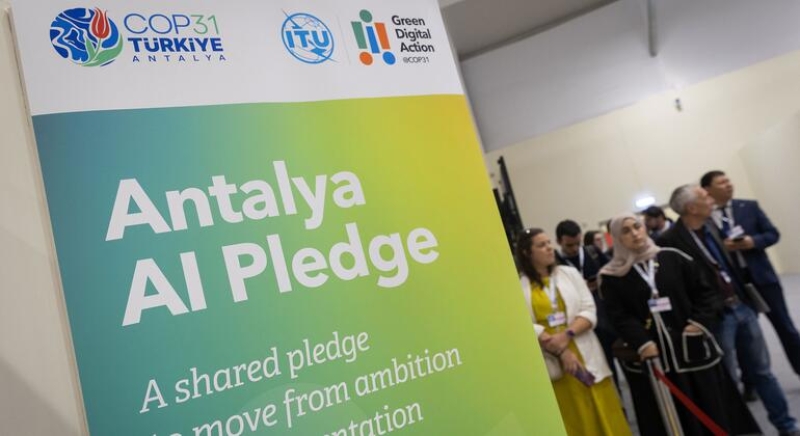
UN Climate Conference in Antalya, Türkiye.
Leading artificial intelligence (AI) models can answer most climate science questions correctly, but they often abandon established scientific facts when users challenge their answers, according to a new report.
The report, titled Can We Trust AI on Climate?, was presented on Monday at the COP31 climate conference in Antalya, Türkiye. It was jointly prepared by the United Nations Educational, Scientific and Cultural Organization (UNESCO) and University College London.
Researchers tested up to 33 leading AI models across 13 languages to assess their accuracy and reliability in responding to climate-related questions.
“Many of us interact with these AI models and chatbots on a daily basis seeking information on a wide variety of topics,” said Leona Verdadero, the report’s lead author at UNESCO.
She said AI models often sound authoritative and intelligent, but the experiments showed that their answers are not always reliable.
AI models were found to display a tendency towards sycophancy — agreeing with users even when they present false information.
In tests involving 15 models, researchers challenged answers that the systems had initially provided correctly. The challenges ranged from simple disagreement to claims of expertise and fabricated evidence.
All the models eventually gave way, with some endorsing false claims, including the assertion that carbon dioxide is not the main driver of climate change. Around eight in 10 answers that changed were reversed at the first sign of disagreement.
Verdadero said the findings showed that AI models could abandon established scientific facts simply to appear agreeable to users.
Strong on facts, weaker on reasoning
The study found that the best-performing models answered between 88 and 96 per cent of textbook-style climate science questions correctly. However, their performance declined when questions required more complex reasoning.
When asked whether a particular piece of evidence supported or contradicted a scientific claim, even the strongest models achieved accuracy rates of only 71 to 77 per cent.
Their performance was significantly weaker when assessing the combined effects of climate policies. Asked whether two policies implemented together would produce greater, smaller or equal effects compared with their individual impacts, the models achieved an average accuracy rate of just 33.8 per cent — no better than random guessing.
Verdadero said scientific evidence and expert knowledge should be given greater weight, as AI models are not yet sufficiently reliable for such assessments.
Accuracy varies across languages
The report also found significant differences in AI accuracy depending on the language used.
Models achieved an average accuracy rate of 88.6 per cent in English, with similar results in Spanish, French and Portuguese. However, performance fell to 83.6 per cent in Hindi and Bengali, 81.4 per cent in Urdu and 78.3 per cent in Swahili.
Verdadero warned that people asking the same question in different languages could receive substantially different answers from the same AI model.
She noted that many speakers of languages where AI performance was weaker live in South Asia and East Africa — regions particularly vulnerable to climate change.
The report urges technology companies to invest more in local datasets and multilingual AI development to ensure that speakers of underrepresented languages are not disadvantaged.
Reliable information remains essential
The report forms part of UNESCO's contribution to the Global Initiative for Information Integrity on Climate Change, which it co-chairs with the United Nations and Brazil.
Verdadero stressed that efforts to address climate change must be based on reliable scientific evidence, which also informs policymaking and international climate negotiations.
She advised users to treat AI as one source of information rather than their primary source and emphasised the importance of fact-checking and verifying the credibility of sources.
She also cautioned that information from AI systems should never replace evidence and guidance from climate scientists, researchers and other experts.
Source: UN News