

- COP31: Bangladesh Calls for Grants to Ensure Climate Justice |
- Bangladesh, Türkiye Leaders Hold Bilateral Talks |
- Climate talks start in Antalya, after wrangle over agenda items |
- 8 Die of Dengue as 1,595 More Are Hospitalised |
- Hasina to Face Execution Process if She Returns: Prosecutor |
COP31: Bangladesh Calls for Grants to Ensure Climate Justice
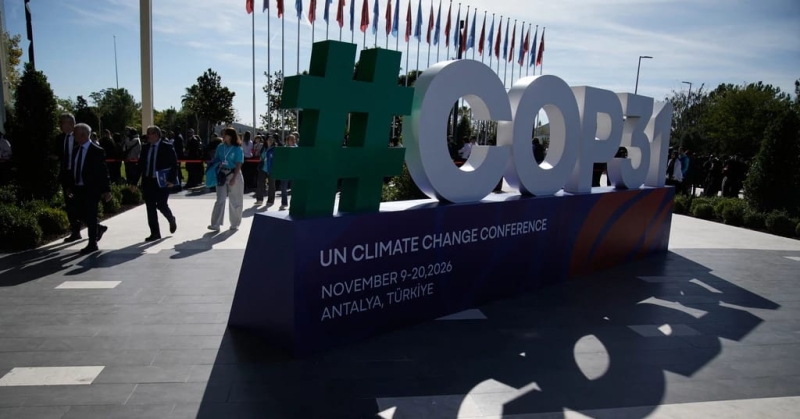
People wait in line near a sign for the COP31 U.N. Climate Summit, Monday, Nov. 9, 2026, in Antalya, Turkey.
Bangladesh will call for increased grant-based climate finance, rather than loans, and greater international support to tackle climate change at the 31st Conference of the Parties (COP31) in Antalya, Türkiye.
As one of the countries most vulnerable to climate change, Bangladesh is seeking a threefold increase in adaptation funding, easier access to international loss and damage funds, technology transfer and financial assistance to strengthen climate resilience.
The country will also stress the responsibility of developed nations to address climate-related damage, calling for favourable financing conditions and more grants to help vulnerable countries respond to the impacts of global warming.
A high-level delegation led by Prime Minister Tarique Rahman is attending the summit to present Bangladesh's priorities and demands.
Bangladesh contributed only 0.05 percent of global greenhouse gas emissions but remains among the countries most vulnerable to the adverse impacts of climate change, Foreign Secretary Salahuddin Noman Chowdhury said.
Securing climate justice is therefore one of the country's foremost priorities, he said, adding that Bangladesh would highlight the historical responsibility of developed countries, climate finance, adaptation, loss and damage, and climate-resilient development.
Threefold increase in adaptation funding
One of Bangladesh's key demands at COP31 is a threefold increase in international funding for climate adaptation.
The country will also seek more resources to address climate-induced loss and damage, greater technology transfer and financial support for adaptation initiatives.
Mirza Shawkat Ali, director of climate change and international conventions at the Department of Environment, said climate finance received particular attention at a recent two-day meeting of the Least Developed Countries group.
He said Bangladesh would call for increased adaptation funding and more resources to address climate-related loss and damage.
He also stressed that adaptation should receive the same level of attention as reducing carbon emissions when addressing the impacts of climate change.
Bangladesh will seek financing under the Global Goal on Adaptation to strengthen resilience and achieve its targets, he added.
Grants instead of loans
Environment, Forest and Climate Change Minister Abdul Awal Mintoo said Bangladesh would emphasise the need for sufficient grant-based climate finance at COP31.
He said grants, rather than loans, should be increased to support adaptation and address climate-induced loss and damage. Bangladesh would also call for simpler application and approval procedures for accessing climate funds.
Cyclones, floods, salinity intrusion, droughts and heatwaves pose serious threats to people's lives, livelihoods and the country's development, he said.
Against this backdrop, Bangladesh is prioritising the protection of climate-vulnerable communities, climate justice and access to financial and technical support to implement its national plans.
The country will seek financial support, technology and capacity-building assistance to implement its National Adaptation Plan and make progress towards global adaptation goals.
Priority will be given to ensuring water, food, health and livelihood security for people living in coastal areas, haors, chars and drought-prone regions. Bangladesh will also seek support for early warning systems and adaptation initiatives led by local communities.
Access to loss and damage funds
Bangladesh will call for increased international support to address climate-related losses and damage, particularly in coastal areas.
The government will place particular emphasis on strengthening mechanisms that allow vulnerable countries and affected communities to access grant-based funding from international loss and damage funds quickly and easily.
The environment minister said climate-related losses and damage were not limited to infrastructure destruction and economic costs. They also included displacement, loss of livelihoods, social and cultural erosion and other economic impacts.
Addressing these challenges requires new and additional international support, he said.
Bangladesh believes the international community has a responsibility to ensure fair financing for countries that contribute the least to climate change but suffer its most severe consequences.
Push for 1.5-degree target and faster emission cuts
Bangladesh will call for rapid, science-based reductions in carbon emissions to help limit global warming to 1.5 degrees Celsius.
The environment minister said developed countries should take the lead in cutting emissions, while major emitting countries should take effective action in line with their responsibilities and capabilities.
Financial and technical assistance will also be needed to help developing countries implement their conditional Nationally Determined Contributions.
Bangladesh will seek international support for environmentally friendly transformations in agriculture, industry, transport and energy.
The country will also highlight the importance of fair distribution of the costs and benefits of the transition, labour rights, skills development, social protection and decent employment opportunities for women and young people.
Renewable energy and technology transfer
Expanding renewable energy and access to environmentally friendly technologies is another major priority for Bangladesh.
The government will seek international cooperation to ensure affordable access to renewable energy, including solar power, energy efficiency, cleaner industries and transport, and climate-resilient technologies.
Bangladesh will also support increased funding for forest, mangrove, wetland and biodiversity conservation, nature-based solutions and climate initiatives led by women and local communities.
The government will further seek cooperation to ensure that international climate measures do not undermine the exports, employment and competitiveness of developing countries.
Although Bangladesh contributes relatively little to global greenhouse gas emissions, it spends substantial resources dealing with the consequences of climate change.
Cyclones, floods, river erosion, salinity intrusion, droughts and heatwaves have long-term impacts on the country's economy, agriculture, infrastructure and people's lives.
For Bangladesh, COP31 is therefore an important opportunity to secure the finance, technology and international cooperation needed to address growing climate risks.
Experts and stakeholders say the country's main challenge will be turning international climate finance commitments into actual funding.
They believe Bangladesh's capacity to deal with climate risks could improve if its demands for increased adaptation finance, easier access to loss and damage funds, technology transfer and grant-based assistance are met.