

- Democrats Take Congress: Five Possible Shifts in Trump’s Foreign Policy |
- COP31: Can Nations Turn Climate Promises Into Action? |
- UN Warns Climate Adaptation Funding Falls Far Short |
- Bangladesh on The Verge of a Solar Energy Revolution |
- Bangladesh Bank Injects $100 Million Into Forex Market |
COP31: Can Nations Turn Climate Promises Into Action?
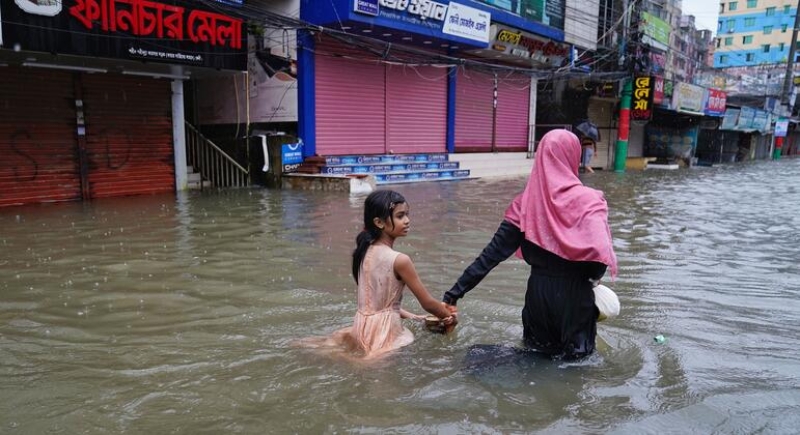
A mother and daughter wade through floodwaters in Feni, southeastern Bangladesh.
The world has more tools than ever to tackle climate change, but millions of people and communities remain unable to benefit from them. As clean energy technologies advance rapidly, the challenge facing countries at COP31 is no longer simply finding solutions but ensuring that everyone can afford and access them.
Catastrophic floods, deadly heatwaves and prolonged droughts have marked 2026, a year in which scientists confirmed that the world is on track to exceed the Paris Agreement's 1.5°C warming threshold.
Against this backdrop, representatives of more than 190 countries will gather in Antalya, Türkiye, from November 9 to 20 for COP31, the latest annual UN climate conference. A powerful El Niño is also expected to intensify climate impacts further.
Although fossil fuels remain the main driver of greenhouse gas emissions, technologies needed to transition away from them are advancing rapidly. Solar power, electric vehicles and battery storage are becoming increasingly accessible.
Yet many countries continue to struggle to benefit from these developments.
Ahead of the summit, UN Special Adviser on Climate Action and Just Transition Selwin Hart spoke about the key issues at stake, the barriers holding back progress and what climate diplomacy can realistically achieve.
What Is COP31 and Why Does It Matter?
COP stands for Conference of the Parties, referring to the countries that are parties to the UN Framework Convention on Climate Change (UNFCCC). The annual gatherings allow governments to assess progress and negotiate collective responses to a challenge that no country can address alone.
The talks produced the landmark Paris Agreement in 2015, when countries committed to keeping global warming well below 2°C and pursuing efforts to limit it to 1.5°C above pre-industrial levels.
The conferences now extend beyond government negotiations. Businesses, scientists, Indigenous Peoples, young people and civil society organisations increasingly participate, reflecting the scale of the challenge.
“There’s now a clear recognition that addressing the climate crisis requires all hands on deck,” Hart said.
What Can a COP Actually Achieve?
A COP is often judged by the agreement reached at the end of negotiations, sometimes after days of difficult discussions and last-minute compromises. But Hart argues that this captures only part of what the conferences can accomplish.
He identifies three ways they can make a difference:
Negotiated agreements: Countries seek consensus on issues such as climate finance, emissions reductions and adaptation, although geopolitical divisions often make ambitious outcomes difficult.
The Action Agenda: Governments, development banks, businesses and civil society organisations work together on practical solutions, including expanding renewable energy, modernising electricity networks and reducing methane emissions.
National commitments: Countries announce domestic actions, including new climate plans, commitments to move away from fossil fuels and contributions to climate funds.
“There’s sometimes this expectation that COPs will always have this big grand deal that will solve the climate crisis. That’s not realistic,” Hart said.
This year, Türkiye will host and preside over the summit, while Australia will lead the negotiations in close cooperation with Pacific Island countries.
The summit will place particular emphasis on implementation. Türkiye is promoting initiatives covering clean energy, food security, resilient cities, greener industries, oceans and waste reduction.
“I’m running a personal campaign to rename the Action Agenda, the Implementation Agenda,” Hart said, underscoring the need to move beyond promises and focus on practical solutions.
What Is on the Agenda in Antalya?
Behind the diplomatic language are decisions that could affect millions of lives. Several major issues remain unresolved:
Climate finance: Developing countries want wealthier nations to fulfil their financial commitments under the Paris Agreement. Disagreements persist over funding responsibilities, access to finance and how global financial flows can be directed towards climate action.
Just transition: Countries agreed last year to establish a mechanism to support the shift to cleaner economies, but still need to decide how it will operate.
Adaptation: Negotiators will continue working on measuring progress, while developing countries press for greater financial support.
Emissions reduction: Governments remain divided over how to strengthen action on emissions and deliver on existing commitments.
COP31 will also launch the second global stocktake, the Paris Agreement's formal process for assessing collective progress towards its long-term goals.
Has the World Already Lost the Fight Against Global Warming?
Scientists warn that the world is on track to temporarily exceed the Paris Agreement's 1.5°C warming threshold, a situation known as overshoot. However, how far temperatures rise and how long they remain elevated will still depend on the choices governments, businesses and societies make today.
“Overshoot is not surrender. Overshoot should really lead to a much greater degree of urgency,” Hart said, calling for faster emissions cuts and greater investment in protecting vulnerable communities.
Despite the warning, he sees reasons for optimism.
“The good news in this horrible situation of overshoot is that the world has never been better equipped to solve this challenge,” he said, pointing to the rapid expansion of electric vehicles, solar energy and battery storage.
What Is Giving the World Hope?
The clean energy transition has changed significantly over the past decade, with technological advances accelerating the shift towards low-carbon energy.
Electric vehicles: Ten years ago, fewer than one in 100 new cars sold worldwide was electric. In 2025, the figure reached one in four and is expected to rise to 28 per cent in 2026.
Solar power: The world added more than 600 gigawatts of solar power capacity in 2025, accounting for over three-quarters of new renewable power capacity.
Battery storage: Global battery storage capacity is now 11 times higher than in 2021. In 2025 alone, the world added 108 gigawatts, 40 per cent more than the previous year. These systems allow electricity generated by solar panels and wind turbines to be stored for later use.
If Solutions Exist, What Is Holding Back Progress?
Clean energy investment has grown rapidly, but its benefits remain unevenly distributed.
Emerging and developing economies outside China, home to nearly two-thirds of the world's population, received just 18 per cent of global clean energy investment in 2025.
Africa illustrates the challenge. Despite its enormous renewable energy potential, the continent attracts only a small share of global investment, while around 600 million people still lack access to electricity.
Hart said access to capital is one of the biggest obstacles. Financing renewable energy projects in developing countries can cost several times more than in wealthier nations, even when the technology is identical.
“Our task now, in this second decade of the Paris Agreement, is to ensure that we remove the barriers to implementation, the barriers to faster action in these economies,” he said.
For countries already struggling with heavy debt burdens, the challenge is particularly difficult. Governments have limited resources to invest in healthcare, education and climate protection.
“We need solutions on finance that will not increase debt,” Hart stressed.
COP31 will not solve the climate crisis in two weeks. But it could help remove some of the barriers standing between the solutions already available and the people who need them.
For millions living with the consequences of a warming planet, that is what will matter long after the summit ends.
Source: UN News