

- Food Safety court fines Sylhet chips factory Tk1 lakh for faults |
- Father, two sons get life term for killing boy (7) in Jamalpur |
- TIB calls 1-day talk on enforced disappearance law a mockery |
- Climate Alarm ‘Blaring’ as Disasters Intensify: UN |
- ‘Top Criminal’ David Emon Held While Fleeing to India |
Climate Alarm ‘Blaring’ as Disasters Intensify: UN
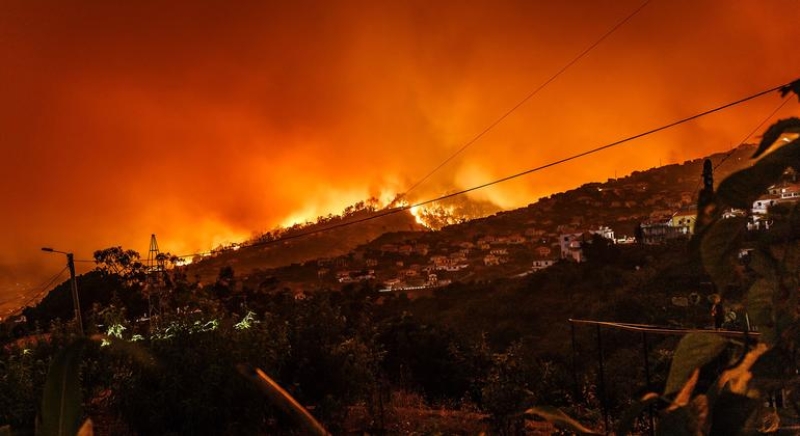
A wildfire burns on the hills of Estreito da Calheta, Portugal. (file)
Climate-driven disasters are reaching “nightmare proportions” due to humanity’s continued dependence on fossil fuels, a top UN climate official warned on Tuesday.
“The climate alarm is blaring from every direction,” said UN Climate Change Executive Secretary Simon Stiell in a statement.
“With temperatures set to soar again this week, the devastating costs of this climate crisis — both human and economic — are reaching national emergency levels.”
Why it matters
More than 250,000 hectares of land in Europe have burned, with 1,254 fires detected since the start of 2026.
Record-breaking wildfires are spreading across France, Spain and other parts of Europe, forcing mass evacuations and damaging regional and national economies after severe heatwaves dried out landscapes.
In North Africa, temperatures are nearing 49°C, threatening lives and livelihoods while putting hospitals and power systems under severe strain.
Deadly storms in Chile have destroyed homes and claimed lives.
Japan has recorded its longest-ever streak of temperatures reaching 40°C as heat records continue to fall.
Clear solutions needed
Stiell said these “spiralling disasters” have become the reality for billions of people in a rapidly warming world, as humanity moves too slowly away from fossil fuels and fails to adequately protect forests.
The science behind the climate crisis is clear, he said, stressing that global warming caused by burning “colossal amounts” of coal, oil and gas is making prolonged heatwaves, extreme floods and powerful storms more frequent, intense and costly.
“What needs to be done is equally clear: leave coal, oil and gas behind faster, scale up renewables and protect people where the impacts are already hitting hardest,” Stiell said.
He added that many vulnerable countries on the front lines of climate change need greater support to respond at the speed and scale required to prevent further damage.
Wildfires' far-reaching impact
In 2023, smoke from Canadian wildfires travelled across the northeastern United States and the Atlantic Ocean, creating health risks and highlighting the far-reaching impact of wildfire pollution.
This summer, Canadian wildfires again sent orange haze across parts of New York state, prompting air quality warnings.
The World Meteorological Organization (WMO) said wildfire smoke can travel thousands of kilometres, crossing borders, oceans and continents. Understanding where smoke will spread has become an increasingly important scientific challenge.
Monitoring and addressing wildfire smoke risks are essential, with early warnings allowing governments and communities to take timely protective measures.
Early warnings are key
WMO said reliable monitoring, forecasting, cross-border data sharing and early warning systems are critical to protecting lives, livelihoods and ecosystems.
Through the Early Warnings for All initiative, WMO is working to strengthen these systems by promoting common frameworks, improving cooperation and supporting international collaboration on fire weather services.