

- Experts Call for Better Flood Forecasting, Urban Planning |
- Fakhrul Urges Public to Ignore Resignation Rumours |
- President Shahabuddin Set to Resign Today: Agency |
- Trade Deficit Widens 24% Despite Record Remittances |
- Modi Invites Tarique to BRICS Summit in India |
Experts Call for Better Flood Forecasting, Urban Planning
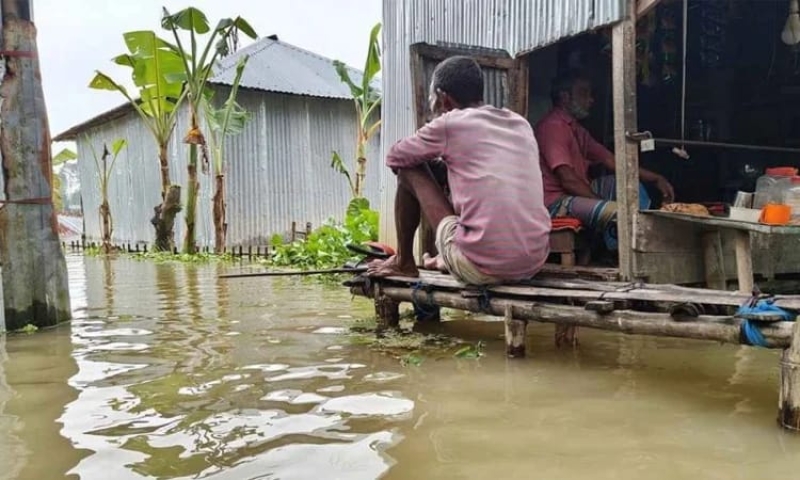
Bangladesh needs more accurate flood forecasting, greater investment in disaster management and improved urban planning to reduce losses from increasingly frequent floods caused by climate change and rapid urbanisation, experts have said.
Professor Dr Md Humayun Kabir, Dean of the Faculty of Earth and Environmental Sciences at the University of Dhaka, said strengthening flood forecasting and early warning systems should be a top priority, as timely information can significantly reduce casualties and economic damage.
“If reliable forecasts are available in advance, authorities can operate drainage pumps before water accumulates, emergency services can be mobilised and people can take precautionary measures to protect their lives and property,” he said.
He stressed the need for modern weather monitoring systems, including fully functional weather radars, real-time rainfall and river monitoring, and stronger coordination among agencies responsible for weather forecasting, water resources and disaster management.
Professor Humayun also called for increased budget allocation for disaster management to improve forecasting capacity, preparedness and emergency response.
He urged the government to adopt long-term urban water management strategies by restoring Dhaka’s canals, wetlands and surrounding water bodies to improve natural drainage during heavy rainfall.
According to him, years of unplanned urbanisation have disrupted the capital’s drainage system through the encroachment of canals and wetlands, filling of ponds and low-lying areas, and the loss of open spaces.
To reduce waterlogging, he recommended improving drainage systems, restoring wetlands, maintaining retention ponds and promoting rainwater harvesting as part of climate adaptation efforts.
“Rainwater should be treated as a resource rather than waste. If rainwater harvesting is promoted in public and private buildings, it will not only reduce waterlogging but also ease pressure on groundwater,” he said.
Professor A.K.M. Saiful Islam of the Institute of Water and Flood Management (IWFM), Bangladesh University of Engineering and Technology (BUET), said Bangladesh faces multiple types of flooding, including urban floods, river floods, flash floods, hill-torrent floods and lowland floods, each requiring different solutions.
Explaining recent flooding, he said a monsoon depression carried large amounts of moisture from the Bay of Bengal into eastern Bangladesh, causing intense rainfall as the air rose over hilly areas.
“Chattogram recorded around 413 millimetres of rainfall in a single day and nearly 850 millimetres over three days, exceeding the capacity of rivers and drainage systems,” he said.
Professor Saiful Islam said climate change is increasing atmospheric moisture, making extreme rainfall events more frequent and intense.
However, he noted that heavy rainfall alone is not responsible for severe urban flooding. Rapid and unplanned urbanisation, encroachment of wetlands and canals, blocked drainage channels and poor waste management have significantly increased flood risks.
He said many drainage systems have lost much of their capacity due to garbage accumulation.
“No matter how many new drains are constructed, they will not function effectively unless existing drains are cleaned regularly and solid waste is managed properly with active public participation,” he said.
The experts stressed the need for strict enforcement of urban master plans, building regulations and zoning policies, along with better maintenance of drainage infrastructure and embankments.
They said accurate forecasting, science-based urban planning, restoration of natural water bodies, rainwater harvesting and stronger institutional coordination are essential for Bangladesh to better manage rising flood risks in a changing climate.