

- Pricing pollution: Does it work? |
- 13 years of Rana Plaza tragedy: Workers want justice, pay tribute |
- Minister Mahbub visits July Uprising injured on treatment in Thailand |
- Iran FM Araghchi heads to Islamabad for US talks resumption |
- Coast Guard seizes illegal fuel, adulterated edible oil in Bhola |
Dhaka’s air poses health risks to sensitive groups
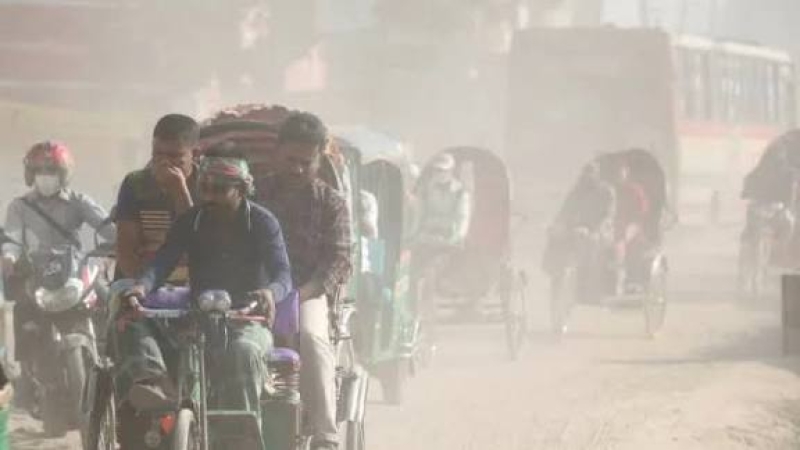
Dhaka, the densely populated capital of Bangladesh, ranked 8th among the world’s most polluted cities on Monday morning, with an Air Quality Index (AQI) of 145 at 09:15 am.
The air was classified as ‘unhealthy for sensitive groups’, meaning it could pose health risks to people who are more vulnerable, according to the AQI scale.
India’s Delhi, Vietnam’s Hanoi and Pakistan’s Lahore were the three most polluted cities, with AQI scores of 210, 185 and 178.
An AQI between 101 and 150 is considered ‘unhealthy for sensitive groups’, while 151–200 is ‘unhealthy’, 201–300 is ‘very unhealthy’, and anything above 301 is ‘hazardous’ and can cause serious health problems.
The AQI measures daily air quality, showing how clean or polluted the air is and what health effects people might experience.
In Bangladesh, the AQI is based on five main pollutants: particulate matter (PM10 and PM2.5), nitrogen dioxide, carbon monoxide, sulphur dioxide and ozone.
Dhaka has long faced serious air pollution. The situation usually gets worse in winter and improves during the monsoon season.
The World Health Organization says air pollution causes around seven million deaths worldwide each year, mainly due to stroke, heart disease, chronic respiratory illness, lung cancer and acute infections, reports UNB.