

- Dhaka Tops Global Air Pollution Index Again |
- UN Unveils First Global AI Assessment Report |
- Balogun scores and sees red as US beat Bosnia 2-0 |
- PM reviews projects to ease city’s traffic congestion |
- Efforts underway to bring Hasina back for trial: Shama |
Japanese sweet potato brings new hope to Brahmanbaria farmers
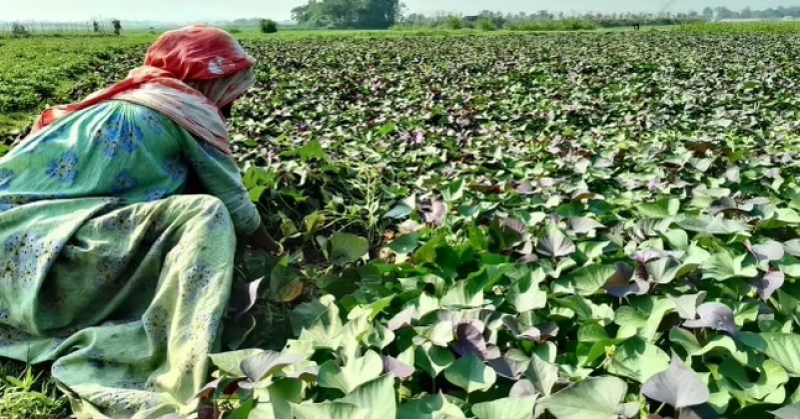
Japanese sweet potato brings new hope to Brahmanbaria farmers
A Japanese variety of sweet potato known as Okinawa is steadily transforming the fortunes of farmers in Nabinagar upazila of Brahmanbaria, as growing consumer demand and high yields turn the crop into a promising superfood.
Although cultivation began on an experimental basis about three years ago, this season recorded nearly 30 bighas cultivation of Okinawa sweet potato in char areas and fallow lands. Farmers, agricultural entrepreneurs and health-conscious consumers are increasingly showing interest in the crop because of its profitability and nutritional value.
Farmers in Sunamganj haor region worried over cattle feed shortage after crop loss
Sweet potatoes are currently cultivated on about 255 hectares of land in Nabinagar upazila.
Around 20 farmers in Natghar, Nabinagar West, Satmora, Barikandi and Birgaon unions are now producing the Okinawa variety, signalling the beginning of what could become a lucrative new crop for the area.
Local farmers said the Okinawa variety produces significantly higher yields than traditional local sweet potatoes. Production can exceed 100 maunds per bigha, while the crop also offers better storage capacity and greater resistance to pests and diseases.
According to farmers, more than three maunds of sweet potatoes can be harvested from each decimal of land, around one and a half times higher than many local varieties. The tubers are larger in size and more visually appealing, making them attractive in the market.
The sweet potato, when boiled or roasted, reveals a distinctive yellow interior with a naturally sweet taste and soft texture. Consumers say slow cooking enhances its flavour, while chilling after boiling further intensifies its sweetness.
Nutrition experts say the crop is widely misunderstood in terms of its impact on blood sugar. With a relatively low glycaemic index, Okinawa sweet potatoes can be consumed in moderation even by diabetic patients. They are also rich in antioxidants, dietary fibre and vitamin A, supporting digestion, eye health and long-term energy release.
The variety is closely associated with Japan’s Okinawa region, known globally for longevity and healthy diets, which has contributed to its branding as a superfood in international markets.
Farmers in Nabinagar say the crop has already begun improving their incomes.
Nur Mohammad of Barikandi village said he started cultivation after receiving training from the Department of Agriculture Extension and collecting vines through local officials.
“Last year, I cultivated it on 20 decimals of land and harvested around 65 maunds,” he said.
Another farmer, Kamal Mia of Darilapang village under Nabinagar West union, said he has been cultivating the crop for two consecutive years on three bighas of land.
“The yield is high, demand is strong, and the price is good. We get around 120 maunds per bigha. It is profitable due to low production costs, so I plan to expand cultivation further,” he said.
Officials say interest in the crop is growing steadily.
Nabinagar Upazila Agriculture Officer Md Jahangir Alam Liton said farmers are increasingly adopting the variety due to its profitability and market demand.
He said initiatives are underway to expand cultivation further through training programmes and vine production, with a target of bringing 100 bighas under Okinawa sweet potato cultivation next season.
However, challenges remain in post-harvest management.
Deputy Director of Brahmanbaria DAE Dr Mostafa Imran Hossain said Bangladesh still lacks adequate storage facilities for sweet potatoes.
He stressed that the development of proper storage systems and agro-processing industries could ensure fair prices for farmers and year-round availability for consumers. - UNB