

- Fuel shortage, rains hit Boro harvest in Habiganj haors |
- 3 killed in truck-microbus collision in Kurigram |
- Heavy rain in Dhaka City, commuters face woes |
- Tropical Forest Loss Slows in 2025, Still Alarming |
- Interbank Dollar rate remains stable at Tk 122.75 |
Fuel shortage, rains hit Boro harvest in Habiganj haors
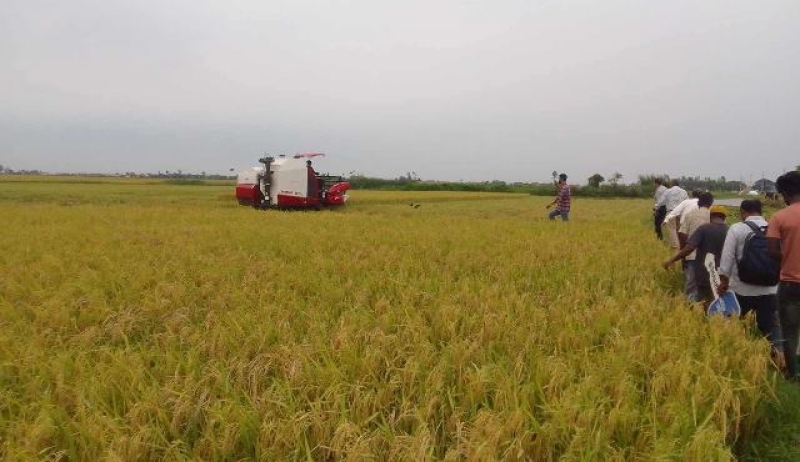
Ripe paddy field ready for harvest in Habiganj haor. Photo - UNB
Habiganj, Apr 28 - Boro cultivation in the haor areas of Habiganj is facing challenges due to a fuel crisis and excessive rainfall while a sharp fall in paddy prices has deepened farmers’ distress.
Besides, Boro paddy is currently selling at around Tk 700 per maund in local markets—less than half of the government-fixed rate, said farmers.
The government has set the procurement price at Tk 36 per kg, equivalent to Tk 1,440 per maund but farmers say they are being forced to sell at even lower prices in the field.
This season, heavy rain and hailstorms submerged vast tracts of Boro fields across the district. Water has yet to recede in many areas, while in some places it continues to rise, further complicating harvesting efforts.
The situation has been worsened by an acute shortage of fuel, disrupting mechanised harvesting.
In Baniachong upazila, the district’s main Boro-producing upazila, only 27 percent of paddy have been harvested as of April 23—15 percentage points lower than the same period last year.
Local trader Suman Ahmed, owner of Bismillah Store in Baniachong sadar, said they were buying paddy from small traders at Tk 700 per maund, while farmers were selling at even lower prices.
According to Department of Agricultural Extension (DAE) data, Boro was cultivated on 123,644 hectares of land across nine upazilas in the district this season, falling short of the target by 204 hectares.
Of the total, 46,954 hectares are in haor areas, with the highest 33,700 hectares in Baniachong alone.
Alok Kumar Chand, sub-assistant plant protection officer at the Baniachong upazila Agriculture Office, said there are 106 combine harvesters in the upazila.
While around 10,000 litres of fuel are required daily, only about 1,000 litres are being supplied, making it difficult to keep the machines operational, he said.
In many cases, harvesters cannot even enter fields due to standing water.
Farmers said they are unable to obtain fuel from filling stations despite having fuel cards, forcing them to buy at higher prices in open market.
Shahid Chowdhury, a farmer from Kumri village, said he was struggling to harvest his crop due to waterlogged fields and fuel shortages. “I didn’t get a single drop of fuel from the pump,” he said.
Authorities urged farmers in haor areas to harvest paddy quickly amid fears of flooding, but a shortage of labour has further compounded the crisis.
Government data shows that around 80 percent of haor paddy has been harvested using machines in recent years.
However, the ongoing fuel shortage and adverse weather have severely disrupted that process this season.
According to the Department of Agricultural Rehabilitation, significant areas of Boro crops in six upazilas have been damaged by rains.
These include 248 hectares in Baniachong, 154 hectares in Ajmiriganj, 90 hectares in Habiganj Sadar, 25 hectares in Lakhai, 20 hectares in Nabiganj and 19 hectares in Chunarughat.
Farmers fear that without urgent and effective measures, Boro production in the haor region could suffer major losses this season. - UNB